Claude Fable 5: First Public Mythos-Class AI Model — Pricing, Benchmarks & Guardrails
Anthropic released Claude Fable 5, the first publicly available Mythos-class model. With an 80.3% SWE-Bench Pro score, $10/$50 per million token pricing, 1M context window, and classifier-based safety system that routes sensitive queries to Opus 4.8.
2026年6月11日 · 阅读约 6 分钟
Key Takeaways
On June 9, 2026, Anthropic released Claude Fable 5 — the first publicly available Mythos-class model, a new tier above the Opus line. Priced at $10/$50 per million input/output tokens (2x Opus 4.8), it delivers a 1M-token context window and state-of-the-art benchmark results. For developers and AI practitioners, this is the most significant model launch of 2026 so far: Fable 5 posts an 80.3% score on SWE-Bench Pro (an 11-point lead over Opus 4.8), compresses months of engineering work into days, and introduces a new class-based safety system that routes sensitive queries (cybersecurity, biology, distillation) to Opus 4.8 as fallback.
What this means for you: If you build AI-powered software, Fable 5 unlocks long-horizon agentic tasks that were previously out of reach. The model is free on Pro/Max plans through June 22 — this is the window to test it against your hardest workflows. The API is available now for production use.
At a Glance
- Release date: June 9, 2026
- Model ID:
claude-fable-5 - Pricing: $10/M input tokens, $50/M output tokens
- Context window: 1M tokens (128K max output)
- SWE-Bench Pro: 80.3% (vs Opus 4.8 at 69.2%)
- Free access: Through June 22 on Pro/Max/Team/Enterprise plans
What Is Claude Fable 5?
Claude Fable 5 is the first Mythos-class model Anthropic has cleared for general availability. "Mythos" is a new capability tier that sits above the Opus class — until now, Mythos-level models were restricted to government cybersecurity partners under Project Glasswing. Fable 5 represents a deliberate tradeoff: Anthropic decided to release the model with safety classifiers that automatically redirect sensitive queries to Opus 4.8, rather than holding the general release until every safeguard was perfect.
The same underlying model, with those classifiers lifted in specific domains, is called Claude Mythos 5 — available only to approved Project Glasswing partners and (soon) select biology researchers through a trusted access program.
Benchmark Performance
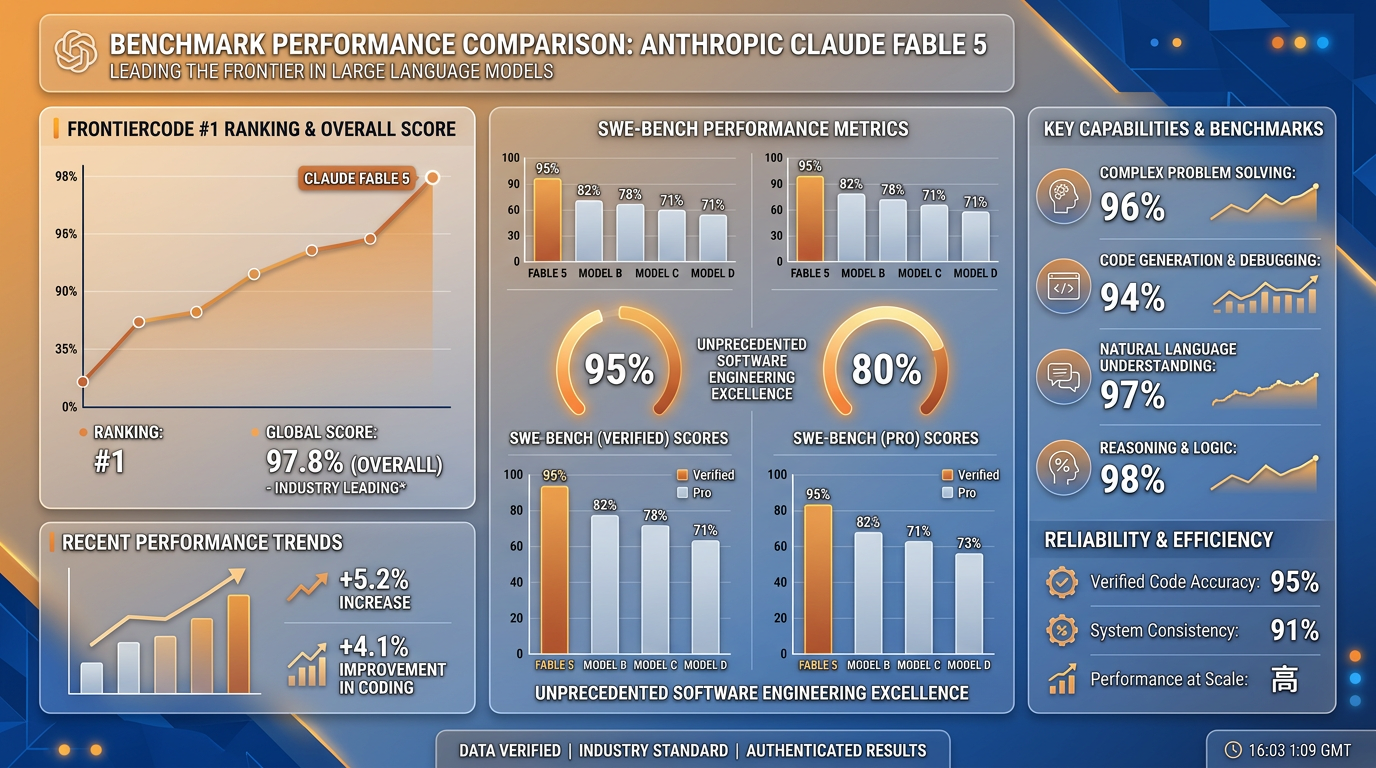
Fable 5 leads nearly every tested benchmark. The most striking numbers are in agentic coding:
| Benchmark | Fable 5 | Opus 4.8 | GPT-5.5 | Gemini 3.1 Pro |
|---|---|---|---|---|
| SWE-Bench Pro | 80.3% | 69.2% | 58.6% | 54.2% |
| SWE-Bench Verified | 95.0% | ~75% | — | — |
| Hebbia Finance (Senior) | Highest | — | — | — |
| CursorBench | State-of-art | — | — | — |
| Biology (AAV design, Mythos 5) | Matches humans | — | — | — |
The 11-point gap on SWE-Bench Pro between Fable 5 and Opus 4.8 is unusual in the current landscape — most recent model generations have been measured in single-digit improvements. Independent tests confirm the margin: one analysis puts Fable 5 at 80.3%, GPT-5.5 at 58.6%, and Gemini 3.1 Pro at 54.2%.
Real-World Performance
Software Engineering
The headline story comes from Stripe: in early testing, Fable 5 performed a codebase-wide migration on a 50-million-line Ruby codebase in a single day — work that Stripe estimates would have taken an entire team over two months by hand.
GitHub also reported strong results: Fable 5 handled complex, long-horizon coding tasks with autonomy and reliability that "exceeded previous benchmarks." Cursor CEO Michael Truell called Fable 5 "state of the art on CursorBench," noting it "opened up a class of long-horizon problems that were out of reach for earlier models."
Knowledge Work and Vision
On Hebbia's Finance Benchmark for senior-level reasoning, Fable 5 achieved the highest score of any model tested. It shows substantial gains in document-based reasoning, chart interpretation, and analytical problem-solving.
For vision tasks, Fable 5 is capable of rebuilding a web app's source code from screenshots alone — a task that previously required multi-step scaffolding with multiple models.
Memory and Long-Context
Fable 5 maintains focus across millions of tokens. Anthropic demonstrated this by having the model play the deck-building game Slay the Spire: with persistent file-based memory, the model's performance improved three times more than when using in-context memory alone. This has direct implications for long-running agent workflows.
Pricing Breakdown
| Plan | Fable 5 Access | Cost |
|---|---|---|
| API (pay-as-you-go) | Full, unlimited | $10/M input, $50/M output |
| Pro ($20/mo) | Free through June 22, then usage credits | 2x usage after June 23 |
| Max ($100/mo) | Free through June 22, then usage credits | 2x usage after June 23 |
| Team | Free through June 22 | Usage after June 23 |
| Enterprise (consumption) | Full, unlimited | API pricing |
The API is fully available from day one for consumption-based Enterprise plans and the standard API. For subscription plans, Anthropic is rolling out more conservatively due to unpredictable demand — the model counts as 2x usage after the free period ends on June 22.
Safety System
Fable 5 introduces a classifier-based safety architecture that is fundamentally different from previous Anthropic models:
- Three classifier domains: Cybersecurity exploits, biology/chemistry (incl. bioweapons), and model distillation (unauthorized capability extraction by foreign actors)
- Fallback to Opus 4.8: When a query triggers a classifier, Fable 5 doesn't refuse — it transparently routes to Opus 4.8, which is itself a highly capable model
- 30-day data retention: All Mythos-class traffic is retained for 30 days on both first- and third-party surfaces
Anthropic reported that external red-teaming organizations failed to find any universal jailbreak across 1,000+ hours of testing. Fable 5 complied with zero harmful single-turn cyberattack requests in third-party evaluation.
This safety system is deliberately conservative — "sometimes benign requests will get redirected to Opus 4.8 when they shouldn't," Anthropic notes. This is the price of a general release of a model this capable.
How to Use Fable 5
API: Use the model ID claude-fable-5 via the standard Anthropic API endpoint.
Claude Code: Fable 5 is available as the default model through the CLI.
Claude.ai: Available on Pro, Max, Team, and Enterprise subscription plans.
Claude Mythos 5: Currently restricted to Project Glasswing partners. A broader trusted access program for cybersecurity and biology organizations is planned.
What Developers Should Do Now
- Test before June 22: The free access window on subscription plans is your opportunity to evaluate Fable 5 on your hardest tasks — codebase refactors, long-running agents, complex multi-step workflows
- Budget for 2x pricing: If Fable 5 becomes your production model, the $10/$50 API pricing is real — plan your cost structure accordingly
- Understand the fallback: If your workflow involves cybersecurity tooling or biology-related queries, expect some requests to be rerouted to Opus 4.8
- Long-context planning: With 1M token context and persistent memory capabilities, design agent workflows that leverage file-based state management rather than cramming everything into a single prompt
Related Content
- Learn Claude Code: Claude Code Content Automation: Build an AI Pipeline in 30 Minutes
- Compare Costs: DeepSeek V4 vs Claude Code: Same Quality, 90% Cheaper API Costs
- Earn with Claude: Claude Code 48-Hour Startup: One Person Built $9K MRR
- Secure Your Agent: AI Coding Agent Security Guide: Add Permission Sandboxes to Claude Code