OpenAI Codex CLI 0.138.0: /app Handoff to Desktop, Multi-Agent v2, and v2 PAT Support
OpenAI shipped Codex CLI v0.138.0 late Sunday June 8, bringing the biggest single-release feature set in weeks. The headline addition is a cross-platform **/app command** that hands off a CLI thread d
2026年6月9日 · 阅读约 5 分钟
OpenAI shipped Codex CLI v0.138.0 late Sunday June 8, bringing the biggest single-release feature set in weeks. The headline addition is a cross-platform /app command that hands off a CLI thread directly into the Codex Desktop app on macOS and native Windows — no more copy-pasting between terminal and desktop sessions.
This release also ships multi-agent v2 with per-thread runtime configuration, v2 personal access tokens (PAT) for both CLI and app-server auth, and a batch of quality-of-life upgrades that make Codex more practical for daily agent-driven development.
The /app Handoff: Closing the CLI-Desktop Gap
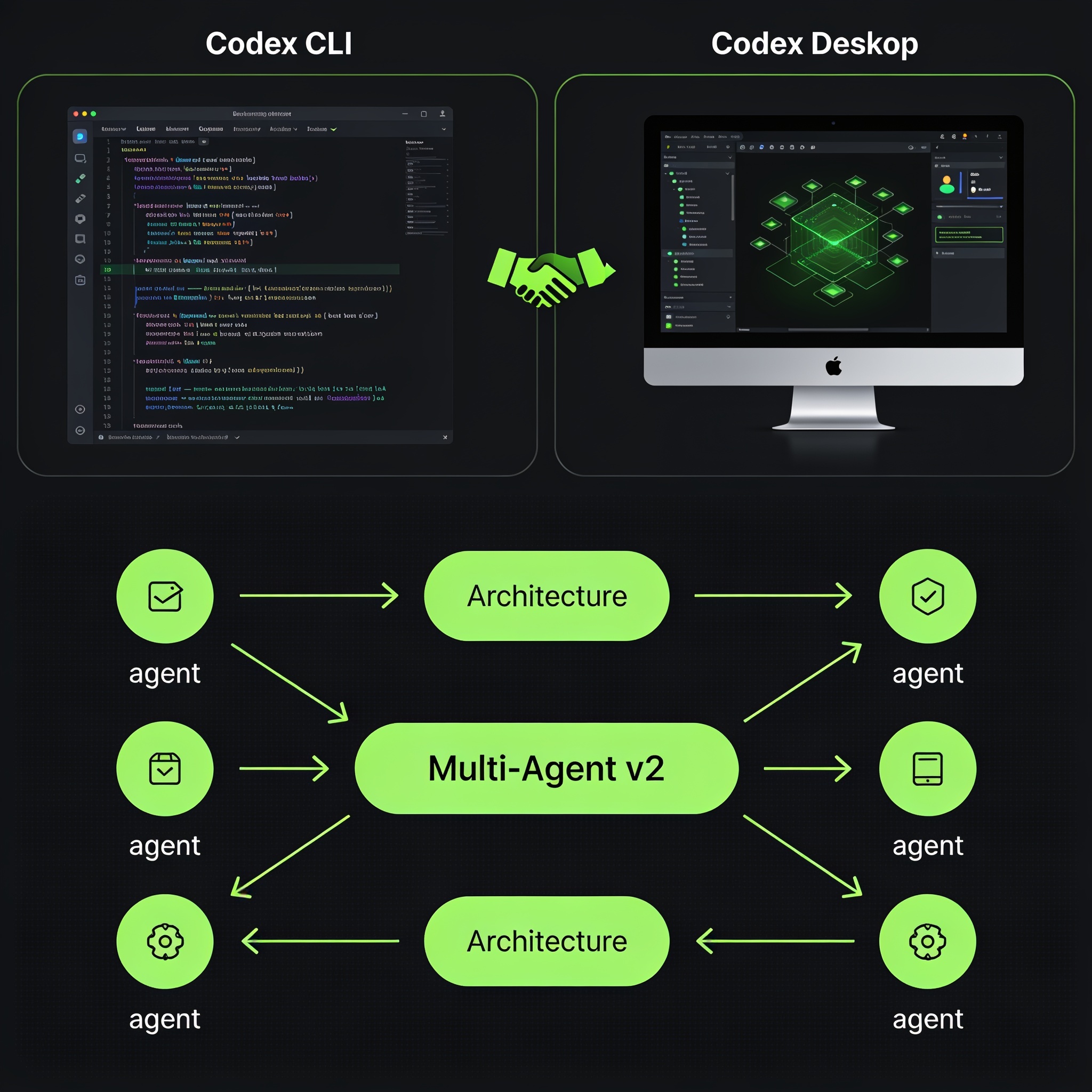
The marquee feature of 0.138.0 is the /app command. Type /app in the Codex CLI and the current agent thread gets transferred to Codex Desktop — including context, running state, and output history. On macOS, the handoff opens directly into the Desktop app. On Windows, workspace launches now default to Desktop instead of stopping at the CLI.
For developers who alternate between lightweight terminal sessions and the richer Desktop interface, this removes a friction point that has been a persistent complaint since Codex Desktop launched. The /app handoff is especially useful when a quick terminal exploration needs to escalate into a full desktop workspace with multiple agents, file browser, and review tools.
Multi-Agent v2: Per-Thread Runtime Control
Multi-agent v2 keeps runtime choice with each thread. That means different agents in the same session can use different model configurations, followed up with cleaner metadata defaults for spawned child agents. The change touches ten separate PRs (#25266, #25636, #25720, #25721, #25722, #25841, #26114), reflecting a systematic rethinking of how Codex manages agent teams.
Key changes in multi-agent v2:
- Each thread persists its own runtime configuration (model, temperature, tool set)
- Spawned agents inherit cleaner defaults without manual override
- Metadata propagation between parent and child agents is more reliable
- The TUI now shows clearer agent role labels and handoff context
This matters because real-world agent workflows rarely use one model for everything. A planning agent might use a cheaper, faster model while a code-generation agent uses a frontier model. V2 makes this native rather than a hack.
v2 Personal Access Tokens for Auth
Codex auth now supports v2 personal access tokens (PAT) in both CLI and app-server flows. This is a direct response to enterprise security requirements — organizations can issue scoped, revocable tokens for CI/CD pipelines, team workflows, and automated deployments without exposing full API keys.
The v2 PAT system also feeds into Codex app-server integrations, which can now read account token usage from the TUI. This gives teams visibility into how many tokens each integration is consuming, useful for cost allocation in multi-developer setups.
Quality-of-Life Improvements
Beyond the three headline features, 0.138.0 packs a dense changelog of smaller upgrades:
- Saved image paths exposed to model: When Codex generates or downloads images, the file path is now available to the model for subsequent processing steps
- App-server Unix socket support: App-server integrations can bind to local Unix sockets, reducing exposed network surface area
- Richer MCP server status: The TUI now shows richer status information for connected MCP servers, including whether they are in stdio mode
- Windows installation improvements: MSVC release binaries no longer depend on separately installed VC++ runtime DLLs, and
codex doctornow detects npm-managed Windows installs - TUI polish: Immediate shutdown feedback on exit, hidden ChatGPT usage link for non-OpenAI providers, and clearer Fast tier state
- Chrome extension cleanup: Fewer tab groups created when taking over existing browser tabs
Release Context: Why This Matters Now
This release comes at a pivotal moment for AI coding tools. GitHub Copilot just launched its agent-native desktop app at Build 2026, Cursor overhauled its pricing model, and Claude Code continues to gain traction among professional developers. Codex v0.138.0 is OpenAI's answer to a market that is rapidly standardizing around multi-agent, multi-model workflows as the default development paradigm.
The /app handoff directly competes with Copilot's new desktop experience and Cursor's IDE-native agent mode. By keeping the CLI as a first-class interface while adding seamless Desktop escalation, OpenAI is betting that power users want both — and the bridge between them is more valuable than either alone.
Multi-agent v2 is a direct response to what the market is demanding: developers don't want one AI assistant that does everything moderately well. They want specialized agents that can be composed. Codex v0.138.0 makes that composition native to the tool.
What This Means for Developers
For WayToClawEarn readers building automation pipelines and agent workflows, three things stand out:
-
The CLI-Desktop bridge solves a real workflow gap. If you've been stuck switching between Terminal and the Desktop app,
/apphandoff is worth the upgrade alone. -
Multi-agent v2 makes practical multi-model setups feasible. You no longer have to choose between a single agent model and a complex orchestration layer just to use different models for different tasks.
-
v2 PATs unlock enterprise CI/CD use. Automated pipelines that need to call Codex without interactive login now have a proper auth mechanism. This directly impacts how teams deploy Codex in staging and production environments.
How to Upgrade
npm install -g @openai/codex@0.138.0
Or download the Desktop app from openai.com/codex to enable /app handoff.