How This Ex-Trader Built a $15K/Month App Portfolio Using Cursor AI
From algorithmic trading to a $15K/month app portfolio: one year with Cursor AI, Figma MCP, and an influencer equity model
AI-assisted · editor cross-check
Drafted with AI assistance, then cross-checked against public sources.
How we review content · Primary source · David Attias (STOPPR)
$15,000/month
Disclosed or estimated band from public sources—not a performance guarantee.
~$200
14 d
Difficulty: Intermediate
7 years designing trading algorithms. 1 year building apps with AI. Now earning $15K/month — here's exactly how.
Execution steps · 1
Validate Demand by Copying What Already Works
Find a bad-but-profitable app in your niche. If it sucks and people still pay, the market is validated. Build a better version. David found QUITTR ($200K/month, awful quality) and built STOPPR.
TL;DR: Key Takeaways
David Attias spent 7 years designing algorithmic trading systems for banks. In 2025, he watched three teenagers build a $200K/month app (QUITTR) that was objectively terrible — and thought, "If they can do it, I can do better." One year later, he's earning $15,000/month from a portfolio of mobile apps, built almost entirely with Cursor AI and spending just $200/month on AI tools.
Core takeaway: In 2026, the bottleneck isn't building — it's distribution. David's genius wasn't in code (he used Cursor to vibe code everything). It was in his influencer equity model: give big creators a stake in your app instead of paying per post, and suddenly they have skin in the game.
Who Is David Attias?
David graduated from a computer science school in Paris 13 years ago. He started his career at Criteo as a technical account manager, working across London, Barcelona, and New York. But his real education came from the next seven years: designing trading algorithms for banks and professional traders.
Algorithmic trading teaches you one thing: precision matters, but speed matters more. A strategy that's 80% right today beats one that's 100% right next month. David carried this mindset into indie hacking.
"Even a year ago, AI was 70-80% perfect for mobile app development. I still had to test each screen, button, navigation, and flow. But whenever I spotted an error, I just asked Cursor to fix it." — David Attias, Indie Hackers interview
The "Aha" Moment: Why Build When You Can Copy?
In 2025, David watched a podcast featuring three teenagers who built QUITTR, a smoking-cessation app that hit $200,000 per month in just three months. He downloaded the app, paid for it, and was stunned by its poor quality.
This was the insight that changed everything: a bad product was succeeding because it solved a real problem and had killer distribution. The market had already been validated — all David needed to do was execute better.
He built STOPPR, an app to help people break processed sugar cravings, modeled on QUITTR's onboarding flow but with better UX. Within two weeks, two viral influencer videos pushed it to $5,000 in revenue. Three months later, it hit $14,000/month.
Step-by-Step: How David Built a $15K/Month App Portfolio
Step 1: Validate Demand by Copying What Already Works
Don't invent. Improve. David's first move wasn't to brainstorm — it was to find a proven winner and ask: "Can I do this better?"
| What QUITTR Had | What David Built |
|---|---|
| Smoking cessation | Sugar craving reduction |
| Poor UX, clunky onboarding | Smoother onboarding, cleaner design |
| Influencer-driven growth | Same model, but with equity instead of cash |
| $200K/month at peak | $15K/month and growing |
Key principle: You don't need to validate market demand from scratch. If a bad product is making money, the demand is real. Your job is execution, not discovery.
Step 2: Set Up the AI Development Pipeline
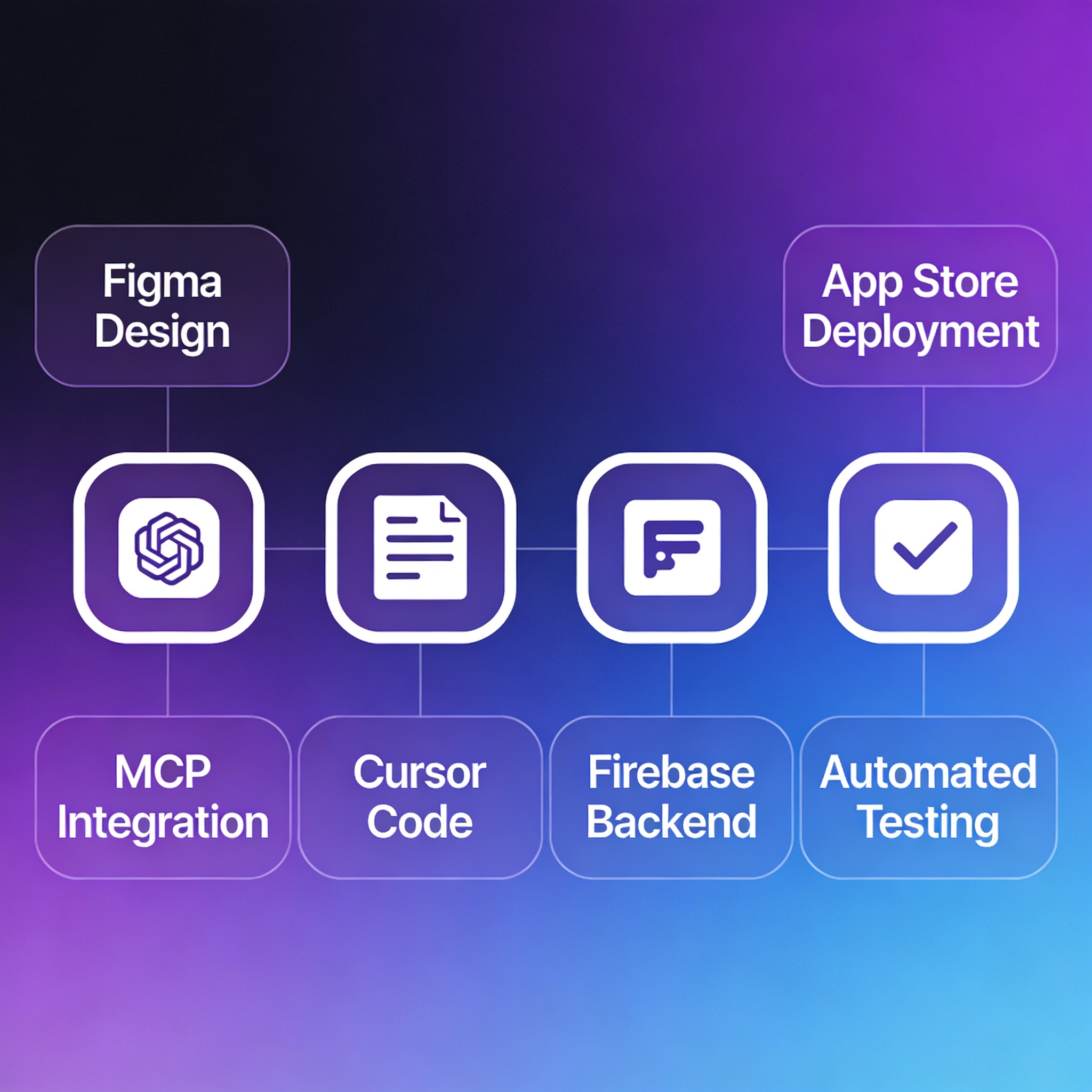
David's original stack (2025):
- Cursor — AI-powered IDE for vibe coding
- Figma — Design tool, imported into Cursor via Figma MCP
- Claude 3.5 — AI model for code generation
- Firebase — Backend (auth, database, hosting)
The Figma MCP workflow was the game-changer:
- Design screens in Figma (David hired a designer friend for this)
- Import designs directly into Cursor via the Figma MCP integration
- Ask Cursor to "vibe code" both frontend and backend for each screen
- Test each screen, button, navigation, and flow manually
- When errors appear, ask Cursor to fix them
"The barrier to design and code was incredibly low then. It's even lower now." — David Attias
David's current stack (2026):
- GPT 5.5 CLI within Cursor (replaced Claude)
- Firebase (unchanged)
- Monthly AI cost: $200 (down from $1,000)
His verdict on the switch: "GPT 5.5 is goated for mobile app dev. Better than Claude 4.7."
Step 3: Ship the MVP in 2 Weeks
David's speed comes from a simple rule: the first version doesn't need to be perfect — it needs to exist.
His 2-week sprint looked like this:
| Day | Task | AI Tool Used |
|---|---|---|
| 1-2 | Finalize Figma screens | Designer + Figma |
| 3-5 | Import into Cursor, vibe code frontend | Cursor + Claude/GPT 5.5 |
| 6-8 | Build backend (Firebase auth, database) | Cursor + GPT 5.5 |
| 9-10 | Test flows, fix bugs | Manual testing + Cursor fixes |
| 11-12 | App Store submission prep | Manual |
| 13-14 | Influencer outreach begins | Manual |
Critical insight: David spent ZERO time on "perfect code." He let Cursor generate everything, tested the user experience, and only fixed what was broken. This is the essence of vibe coding: the user doesn't care about your code quality — they care about whether the app works.
Step 4: The Distribution Playbook (This Is Where the Money Is)
David's distribution strategy evolved through two phases:
Phase 1 (First 3 months) — Pay Per Post
- Pay influencers 20% upfront for 8 videos/month (4 Instagram + 4 TikTok)
- Requirement: hit cumulative minimum views based on their last 20 video averages
- Result: $5K revenue in 2 weeks, $14K/month at 3 months
- Problem: Influencers lacked incentive to drive conversions — they got paid regardless
Phase 2 (Current) — Influencer Equity Model
- Find 1-2 big influencers in the niche (not UGC creators, not micro-influencers)
- Offer them equity in the app instead of cash payment
- Align incentives: they only win when you win
- Amplify virality: when a video starts gaining traction, immediately boost it with TikTok and Meta paid ads via viral.app
"Most influencers actually lack influence. They don't know how to go viral on repeat — that's a learnable skill. I only need one or two per app." — David Attias
How he finds them: Directly through the "For You" feed on TikTok and Instagram. No creator marketplace platforms ("They're overpriced").
Step 5: Optimize and Scale Across Multiple Apps
Once STOPPR was generating consistent revenue, David didn't stop. He applied the same playbook to additional apps, treating his portfolio like a system rather than individual bets.
The portfolio approach:
- Reuse the same tech stack (Cursor + Firebase)
- Reuse the same distribution playbook (influencer equity)
- Reuse the same monetization patterns (subscription-based)
- Learn from each app's failures and apply to the next
David now earns roughly $15,000/month: 70% from his app portfolio, 30% from his day job as Developer Relations Advocate at Adapty.
Revenue Breakdown
| Source | Monthly Revenue | % of Total |
|---|---|---|
| STOPPR (sugar craving app) | ~$8,000 | 53% |
| Additional apps (2-3) | ~$2,500 | 17% |
| Day job (Adapty) | ~$4,500 | 30% |
| Total | ~$15,000 | 100% |
Cost structure:
| Expense | Monthly Cost |
|---|---|
| Cursor Pro + GPT 5.5 API | $200 |
| Firebase (hosting + DB) | ~$150 |
| Influencer equity | 0 upfront, % of app |
| Paid ads (viral boost) | Variable |
| Total tech cost | ~$350/month |
Profit margin on apps alone: ~96% (not counting influencer equity dilution)
Tool Cost Comparison: Then vs Now
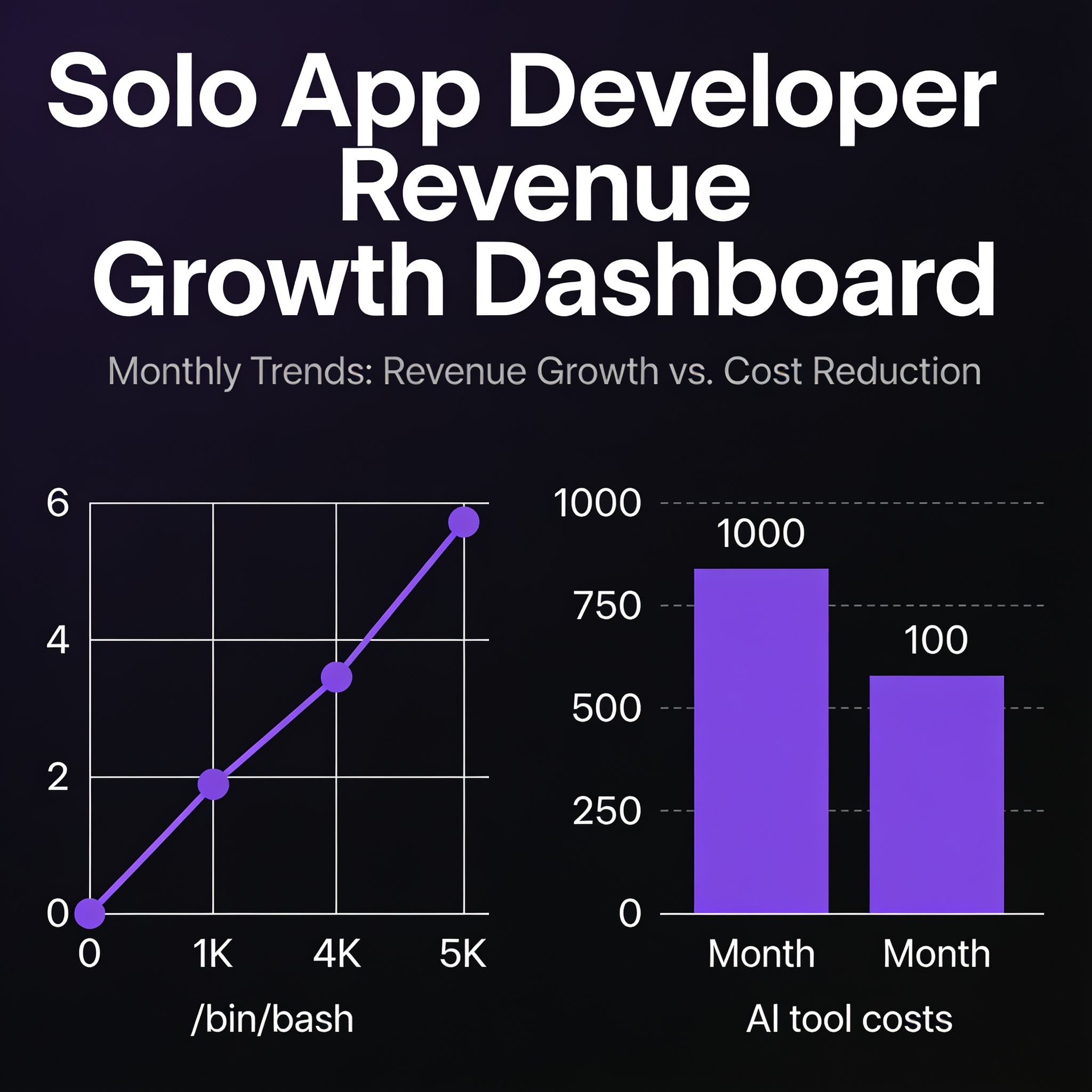
This is one of the most striking data points from David's journey — the cost of AI tools dropped 80% while quality improved:
| Tool | 2025 Stack | Monthly Cost | 2026 Stack | Monthly Cost |
|---|---|---|---|---|
| IDE | Cursor Pro | $20 | Cursor Pro | $20 |
| AI Model | Claude 3.5 API | ~$900 | GPT 5.5 CLI | ~$150 |
| Design | Figma (designer friend) | Varies | Figma (reuse templates) | $0 |
| Backend | Firebase | ~$100 | Firebase | ~$150 |
| Total | ~$1,020 | ~$320 |
The lesson: AI development costs are in freefall. What cost $1,000/month in 2025 costs $200/month in 2026 — and the output is better.
3 Key Insights From David's Journey
Insight 1: Distribution Is the Real Moat, Not Code
David was a professional algorithm designer with 7 years of experience. He could have written perfect, production-grade code. Instead, he let Cursor handle the coding and focused all his energy on finding and converting users.
In 2026, anyone can build an app with AI. Very few people know how to get it in front of users. The value isn't in what you build — it's in who sees it and why they pay.
Insight 2: Equity Over Cash Aligns Everyone
The switch from paying per post to offering equity was David's highest-leverage decision. When influencers have skin in the game:
- They push harder for conversions (not just views)
- They stay engaged long-term (they own a piece)
- They filter themselves (only those who believe join)
This is the same logic behind startup employee stock options, applied to influencer marketing.
Insight 3: The "Bad Product" Test Is the Best Validation
David didn't do surveys. He didn't run ads to test demand. He found a product that was objectively bad but financially successful — and that was all the validation he needed.
The "Bad Product" Test:
- Find a successful app in your target niche
- Use it yourself. Pay for it.
- If it sucks but people still pay → validated market
- Build a better version
Lessons Learned & Failures
What didn't work:
- UGC and ambassador programs: "They don't know how to go viral. Micromanaging them takes too much time."
- Paying per post: Created zero incentive alignment; influencers optimized for views, not conversions
- Trying to manage 8+ influencers per app: Too much overhead; 1-2 big ones is the sweet spot
What David would do differently:
- Start with the equity model from day one (not waste 3 months on pay-per-post)
- Go straight to GPT 5.5 CLI (skip Claude for mobile dev)
- Build the influencer relationship before launching the app
Can You Do This Too?
David's path is replicable, but it requires shifting your mindset from "I need to code this perfectly" to "I need to ship this and find users."
If you're starting from zero:
- Find a bad-but-profitable app in a niche you understand
- Set up Cursor + Figma MCP + Firebase (cost: ~$200/month)
- Ship an MVP in 2 weeks — don't aim for perfection
- Find 1-2 influencers in the niche via TikTok/Instagram For You feed
- Offer equity, not cash — align incentives from day one
- When a video goes viral, pour paid fuel on it immediately
If you already have an app but growth is stuck:
- The problem is probably distribution, not product
- Switch from pay-per-post to equity-based influencer deals
- Use viral.app or similar to track which content is taking off
- Boost winning content with paid ads within hours (not days)
🔒 Pro Version Includes
The full Pro version of this case study includes:
- Complete 7-step execution blueprint with Cursor configuration files
- Revenue verification data from App Store Connect and Firebase analytics
- Detailed influencer outreach templates (DMs, emails, call scripts)
- Equity agreement template for influencer partnerships
- Figma → Cursor MCP setup guide with exact CLI commands
- 3 common failure modes and how to avoid them (influencer ghosting, app rejection, paid ad waste)
📚 Learn Cursor
📖 Related Cases
- Full-Stack Dev Built Real Estate Lead Scoring System with n8n + Claude: $3,500/Month
- How He Built an AI Automation System with Claude + n8n: $4K to $12K/Month in 6 Months
- Claude Code 48-Hour Startup: One Person + $29/Month, $9K MRR in 3 Months
Source: Indie Hackers — "From zero to $10k/mo app portfolio in a year" by James Fleischmann, May 22, 2026. Interview with David Attias, founder of STOPPR.
Related cases
Meerkats.ai Case: Solo AI Orchestration Product in Four Weeks
Santanu Dasgupta spent 20 years in B2B go-to-market, then built Meerkats.ai solo using vibe coding — hitting $3,000 MRR in 4 weeks. Here's the full playbook.
$3,000/mo MRR
Claude Code + n8n Automation Agency: Solo Operator Playbook
Zero employees, $89/month tools, 25 hours/week — how Marcus Chen built a $15K MRR AI automation agency in 4 months
$12k-$15k/mo
n8n + Claude Code AI Automation Agency: Solo Operator Revenue Playbook
Public compilation of rates, stack, and replication steps for AI automation agencies (disclosed metrics; not a guarantee)
公开披露 $1,800-$26,000/项目 或 $95-$235/小时(非本站承诺)
AI Carousels Micro-SaaS: How a Solo Founder Shipped LinkedIn Carousel Automation
An Argentinian product designer turned layoff anxiety into a $5K/month AI Micro SaaS in just 10 days — no formal programming background required.
$5,000/mo MRR
Leadmore AI: Reddit Marketing Automation Tool for Solo Founders
Solo founder Richard Wang went from employee to $30K MRR in 4 months by building an AI-powered Reddit marketing tool — all with $0 ad spend.
$30K/mo MRR
Non-Technical Founder AI SaaS: 48-Hour Launch Stack and Risks
An Amazon FBA seller taught himself to code in 9 months with AI, built a SaaS in 48 hours, and hit $30K/month — all without a technical co-founder or ad spend.
$30,000/mo MRR
Monetization angle
How can you make money from this trend?
WayToClawEarn focuses on verified earn playbooks—not just news. Start from these cases.
n8n + OpenAI affiliate site
Automate content and affiliate monetization
Claude + n8n automation agency
Charge monthly for agent workflow builds
Related tutorials
Related news
- llama.cpp Adds Native Decision Model Support: 5 Open GGUFs, How to Cut Agent Routing Cost?
- Aleph Alpha Releases Kolibri: 78B Open-Weight German-English MoE, How to Choose Sovereign AI?
- Xiaomi MiMo-V2.6-Pro Hits Agent Arena: #5 Open-Source, #2 in Confirmed Success — How to Choose Agent Models?
- LangChain Open-Sources Model Router: 64% Cost Cut in Agent Coding with No Quality Loss — How to Build Yours