OpenAI Codex Harness Engineering Meets Jane Street Claude Design: Agent-First Development Arrives
Two high-impact HN stories on the same day — OpenAI blueprint for Codex harness engineering and a Jane Street designer revelation that Claude Code has replaced Figma — converge on the same thesis: the agent-first era has arrived.
2026年6月7日 · 阅读约 6 分钟
TL;DR
On June 7, 2026, two high-impact stories hit Hacker News simultaneously — OpenAI published "Harness Engineering: Leveraging Codex in an Agent-First World" (240 pts, 156 comments), and a Jane Street designer shared "I Design with Claude More Than Figma Now" (200 pts, 175 comments). Though one comes from the company building the AI coding tool and the other from a practitioner using a different tool, they converge on the same thesis: the era of treating AI coding agents as assistants is over — we are now in the agent-first era where the codebase itself is written for machines as much as for humans.
Key Points
- Story A: OpenAI's engineering blog introduces "harness engineering" — building frameworks that guide AI coding agents with pre-grounding, self-verification loops, and architecture constraints
- Story B: A Jane Street designer describes how Claude Code has replaced Figma entirely for prototyping, building working features directly in the codebase
- Convergence: Both advocate for shifting from "AI as helper" to "AI as primary tool," with the bottleneck moving from code generation to architectural design
- Community: HN debates on both threads reveal polarized reactions — engineers embrace the productivity gains but worry about losing specification rigor
The Two Stories
Story A: OpenAI's Harness Engineering — The Platform's Blueprint
OpenAI's engineering blog published a deeply technical piece on how they structure projects where Codex does most of the heavy lifting. The core concept is "harness engineering" — rather than treating Codex as a copilot to be manually supervised, you build a "harness" that guides the agent:
- Pre-grounding: Brief the agent on the environment upfront, saving massive token waste from exploratory tool calls
- Self-verification loops: Give Codex a browser, smoke tests, e2e tests, and a high-fidelity local environment to verify its own work
- Architecture as constraint: The harness enforces good design splits — agents work within well-defined module boundaries
The results are staggering. One project mentioned in the article hit on the order of a million lines of code across application logic, infrastructure, and tooling in five months. Multiple HN commenters confirmed they've replicated the pattern with both Codex and Claude Code.
A key insight from the HN thread: commenter shepherdjerred noted this mirrors exactly what they've been doing with Claude — "Give Claude Code a way to verify its own work (browser, smoke tests, e2e tests, high-fidelity local environment), keep all context (issue tracker, docs, sentry logs) in an MCP server, and define clear boundaries with architecture docs."
Story B: Jane Street Designer — Claude Code Replaces Figma
Meanwhile, a designer at Jane Street (Edwin) published a personal reflection titled "I design with Claude more than Figma now" that went viral with 200 points and 175 comments.
The key shift: instead of laboring over spec docs, building Figma mockups, writing proposals, and reviewing implementation with devs, Edwin now builds prototype features that do the exact thing they have in mind directly in the codebase. Using Claude Code, they create working prototypes that reviewers can interact with — not static mockups.
"All the effort spent on this feature went into improving the real artifact, and none on ancillary in-between work like creating Figma components or formatting docs."
The HN comment section reveals this is a broader trend. User bobkb shared: "At work we are now in the process of migrating away from Figma. We spent years perfecting our Figma-based design workflow. Currently, we are moving all the designs into the code itself using Storybook + AI-generated components."
However, there's also pushback. User kcrwfrd_ (a frontend engineer) wrote: "Written specifications are being reduced in favor of these working prototypes, and honestly I really miss the old way of doing things. Reviewers are given a fully baked feature with zero input on the functionality."
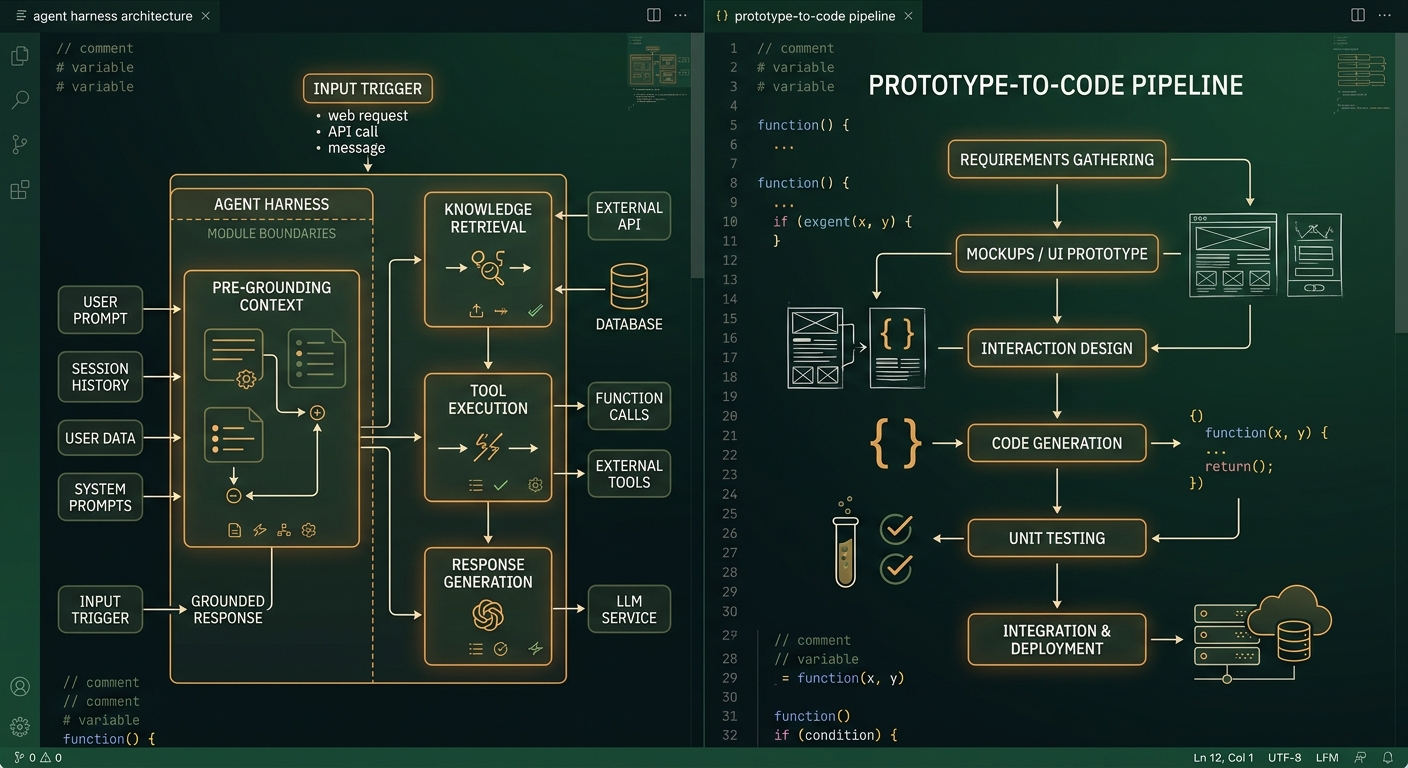
Convergence: The Agent-First Development Paradigm
What links these two stories is not just timing — it's a structural shift in how software is built:
| Dimension | Story A (OpenAI Codex) | Story B (Jane Street/Claude) |
|---|---|---|
| Perspective | Tool builder's blueprint | Practitioner's narrative |
| Core insight | Harness engineering = pre-grounding + self-verification + architecture constraints | Prototyping directly in code replaces spec docs + mockups |
| Target user | Engineering teams scaling agentic workflows | Designers and product builders |
| Scale evidence | 1M lines of code in 5 months | Full features prototyped in hours |
| Key concern | Architectural integrity at scale | Review becomes harder with fully baked features |
| AI tools mentioned | Codex, OpenAI | Claude Code, Claude, Cursor |
The common thread: when AI agents become the primary development tool, the bottleneck shifts from code generation to architectural design and review. Both articles implicitly agree that the key skill for developers going forward is not writing code but designing systems that agents can navigate safely.
Community Reactions
On HN, both threads sparked vigorous debates. Key themes:
For the OpenAI article: Skepticism about engineering blog quality. Commenter h4ny wrote: "I'm not an AI skeptic but I'm skeptical of the intent of this article. OpenAI wants to sell Codex subscriptions." Others like drivebyhooting wished for more didactic walkthroughs.
For the Jane Street article: The discussion split between designers and engineers. Designers largely embraced the shift, while engineers worried about losing specification rigor. Commenter lifeisstillgood highlighted the key tension: "prototypes are living proposal docs, the code is disposable, and a reviewer's job is to give feedback about the design."
The designer community was particularly supportive. Commenter designerarvid noted: "The benefit here is designers learning to code. It was always weird to me that designers were shaping software without knowing how it was built."
Practical Takeaways
-
For engineering teams: Start building a "harness" — pre-grounding context, automated verification loops, and architectural guardrails — before scaling agentic workflows. The companies getting the most value out of Codex and Claude Code aren't those with the best prompts, but those with the best frameworks around their agents.
-
For product teams and designers: Learning to prototype directly in code (with AI assistance) is becoming a superpower. Tools like Claude Code and Codex are lowering the barrier for non-engineers to create working software. This doesn't replace design thinking — it accelerates the feedback loop.
-
For the broader industry: The "designer-coder" split is dissolving. As one HN commenter noted, "If everyone is a generalist, the price of a generalist falls." But the counterpoint is that architects and system designers — those who can design the harness, not just write code within it — are becoming more valuable, not less.
Related Reading
- Want to learn how to set up agent harnesses? Check our AI coding agent setup guide
- See how developers are making money with Codex and Claude: AI tool case studies
- Explore more tools like Codex and Claude Code: AI coding tools directory