OpenAI Codex vs Microsoft Scout: The 2026 Enterprise AI Agent Battle
OpenAI launched six role-specific Codex plugins and Sites for knowledge workers. Microsoft unveiled Scout, its first OpenClaw-based Autopilot agent. Same day, two strategies for enterprise AI agents.
2026年6月7日 · 阅读约 6 分钟
Key Takeaways
- OpenAI launched six role-specific Codex plugins on June 2, covering 62 business apps and 110 automated skills for analysts, marketers, designers, investors, product teams, and sales
- Microsoft unveiled Scout, its first "Autopilot" agent, built on OpenClaw, that works continuously across Microsoft 365 without needing prompts
- Codex now has 5M+ weekly active users, with knowledge workers (20% of users) growing 3x faster than developers
- Scout is available in private preview through Microsoft's Frontier program, with broader rollout TBD
- Both announcements signal that the AI agent market is shifting from developer tools to enterprise knowledge-work platforms
Open AI Codex: From Developer Tool to Knowledge-Work Platform
On June 2, 2026, OpenAI announced its most significant Codex expansion to date — transforming the product from a coding assistant into a role-aware enterprise work system. The launch included three major components:
Six Role-Specific Plugins
OpenAI introduced plugins designed around actual business jobs rather than generic prompts:
| Plugin | Target Users | Key Capabilities |
|---|---|---|
| Data Analyst | Analytics teams | Query databases, build dashboards, automate reporting |
| Creative Producer | Design/marketing | Generate assets, edit content, manage creative workflows |
| Product Builder | Product managers | Spec writing, user story generation, roadmap planning |
| Sales Prospector | Sales teams | Lead research, outreach drafting, pipeline analysis |
| Investment Analyst | Finance/investors | Financial modeling, market research, deal memo creation |
| Growth Marketer | Marketing teams | Campaign analysis, content strategy, performance reporting |
Collectively, the six plugins bundle 62 business applications and 110 automated skills. OpenAI says more role-specific plugins are coming, including Corporate Finance, Private Equity Investing, Marketing Strategy, Strategy Consulting, and Legal.
Codex Sites
Codex Sites lets Business and Enterprise customers generate and share interactive hosted websites and lightweight internal apps using natural language. Instead of static files, teams can create living dashboards, review hubs, planners, project boards, and other collaborative surfaces — all shareable by URL inside the workspace.
Sites are currently in preview for eligible Business and Enterprise workspaces.
Annotations for Documents and Spreadsheets
The annotation feature, previously limited to code, now extends to documents, spreadsheets, slides, and sites. Users can point Codex at a specific section and request a targeted revision, making it practical for collaborative document workflows.
The Numbers Behind the Shift
OpenAI shared significant adoption data: Codex now has more than 5 million weekly active users, up 6x since the desktop app launched in February. Knowledge workers now represent about 20% of users and are growing more than three times as fast as developers.
The company's own report noted growing Codex usage in research, data analysis, workflow automation, and artifact creation — reports, spreadsheets, presentations, and contracts. Enterprise customers like Zapier use Codex across Slack, Google Docs, and Coda for postmortems and feature tickets, while NVIDIA uses it to accelerate research workflows.
Microsoft Scout: The Always-On Autopilot Agent
Also on June 2, but at Microsoft Build 2026 in San Francisco, Microsoft announced Scout — its first "Autopilot" agent, representing a new category of AI assistant that doesn't wait for prompts.
What Makes Scout Different
Microsoft's framing is deliberate. Scout is not a chatbot. It is an always-on agent with its own persistent identity that works continuously across Microsoft 365:
| Feature | Copilot | Scout |
|---|---|---|
| Interaction model | Reactive (prompt → response) | Autonomous (always-on, proactive) |
| Initiative | User starts every interaction | Agent acts without waiting |
| Identity | User session context | Own persistent Entra identity |
| Scope | Single-task per prompt | Continuous work across apps |
| Memory | Session-limited | Work IQ long-term context |
Scout proactively manages calendars, coordinates meeting times across time zones, flags important meetings, generates prep materials, identifies upcoming deliverables, blocks focus time, and spots stalled decisions or risks.
Built on OpenClaw
Scout is powered by OpenClaw, the open-source agent framework that has reached 180,000 GitHub stars since its January 2026 launch. Microsoft is contributing policy conformance capabilities directly upstream to OpenClaw, meaning any organization running OpenClaw can validate enterprise security compliance.
Scout operates on the MXC (Microsoft Execution Containers) platform with OpenClaw running natively on Windows. Every agent operates under its own governed Entra identity with scoped credentials, redacted from logs, and managed with first-party Microsoft service rigor.
Availability and Pricing
Scout is available as an experimental release through Microsoft's Frontier program. Access requires Frontier enrollment, Intune policy configuration, an opt-in attestation, and a GitHub Copilot license. Internal adoption at Microsoft grew from 100 to over 3,000 daily active users within a week.
For M365 E5/E3 customers, Scout is included at no extra charge for up to 5,000 agent actions per user per month, with additional actions priced at $0.0004 each.
The Big Picture: Two Strategies, One Trend
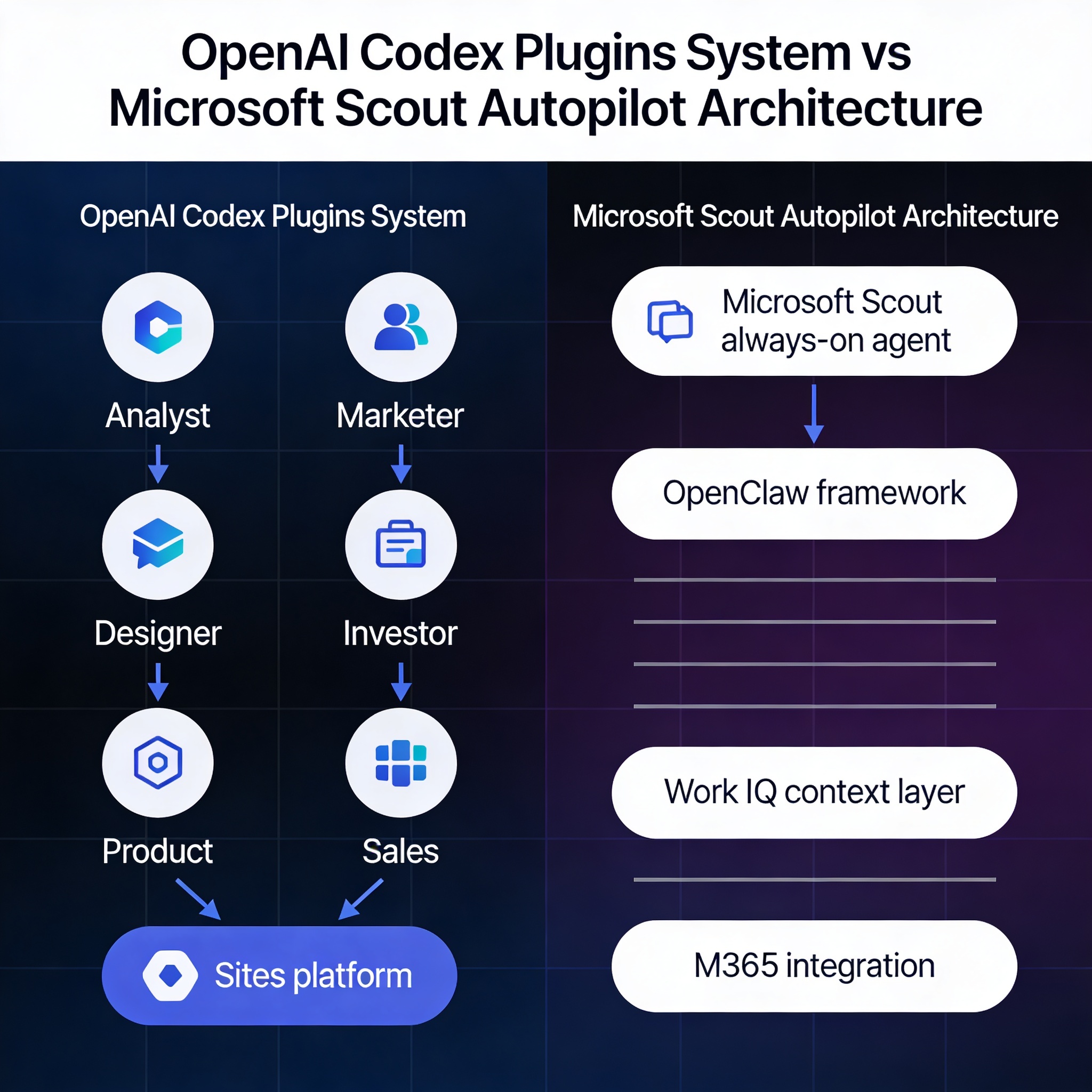
Both announcements — separated by a few hours on the same day — point to the same industry shift: AI agents are moving beyond developer tools into enterprise knowledge work. But the strategies diverge in important ways.
OpenAI's approach is plugin-and-platform: bundle specific workflows around business roles, let users bring their own tools, and distribute through the existing Codex/ChatGPT ecosystem. The plugin directory opens up for external partners, creating a marketplace dynamic.
Microsoft's approach is infrastructure-and-identity: wrap OpenClaw with enterprise governance (Entra ID, Purview compliance, Intune policy), embed it into the M365 surface where knowledge workers already live, and sell it as part of the enterprise stack.
| Dimension | OpenAI Codex | Microsoft Scout |
|---|---|---|
| Core philosophy | Role-specific plugins + platform | Always-on agent + enterprise governance |
| Architecture | Cloud API + plugin directory | OpenClaw local agent + Work IQ context |
| Distribution | Codex app/ChatGPT ecosystem | M365 E5/E3 + Frontier preview |
| Target user | Individual knowledge worker | Enterprise organization |
| Open-source | Proprietary | Built on OpenClaw (open-source) |
| Governance | RBAC + Compliance API | Entra ID + Purview + Intune |
| Pricing | Business/Enterprise tier | Included in E5/E3 (up to 5K actions/mo) |
For developers and operators building on these platforms, the practical question isn't "which one is better" — it's "which ecosystem fits my delivery model." If you need role-specific workflow bundles and fast iteration, Codex's plugin model offers more flexibility today. If you need governed, auditable agents inside an existing M365 deployment, Scout's enterprise controls and OpenClaw foundation make it the safer bet.
The deeper signal is that both companies see the same endpoint: AI agents that don't just answer questions but produce real, shareable, governed work output. The battle for enterprise AI is no longer about model quality alone — it's about workflow packaging, permissions, and operational fit.
Related Reading
- Want to learn how to use Codex for automation? Check out our Codex Mobile Tutorial
- See how OpenClaw agents can generate real revenue: OpenClaw AI Agent Case Study
- Compare AI agent options in our AI Coding Agent Selection Guide
- Learn about OpenClaw automation: OpenClaw + ChatGPT Content Rewriting Tutorial
Why This Matters for Your AI Tool Stack
- If you're already on M365, Scout means your enterprise agent infrastructure is arriving faster than expected
- Codex plugins signal that AI tools are becoming role-specific — the age of "prompt engineering" as a general skill is fading
- The OpenClaw connection makes Scout relevant even if you're not in the Microsoft ecosystem — the upstream policy contributions benefit all OpenClaw users
- For affiliate operators and content creators: both platforms will create new opportunities for tutorial content, integration guides, and use-case case studies