S&P 500 Rejects SpaceX Fast-Track Entry, Blocking OpenAI and Anthropic from Passive Funds
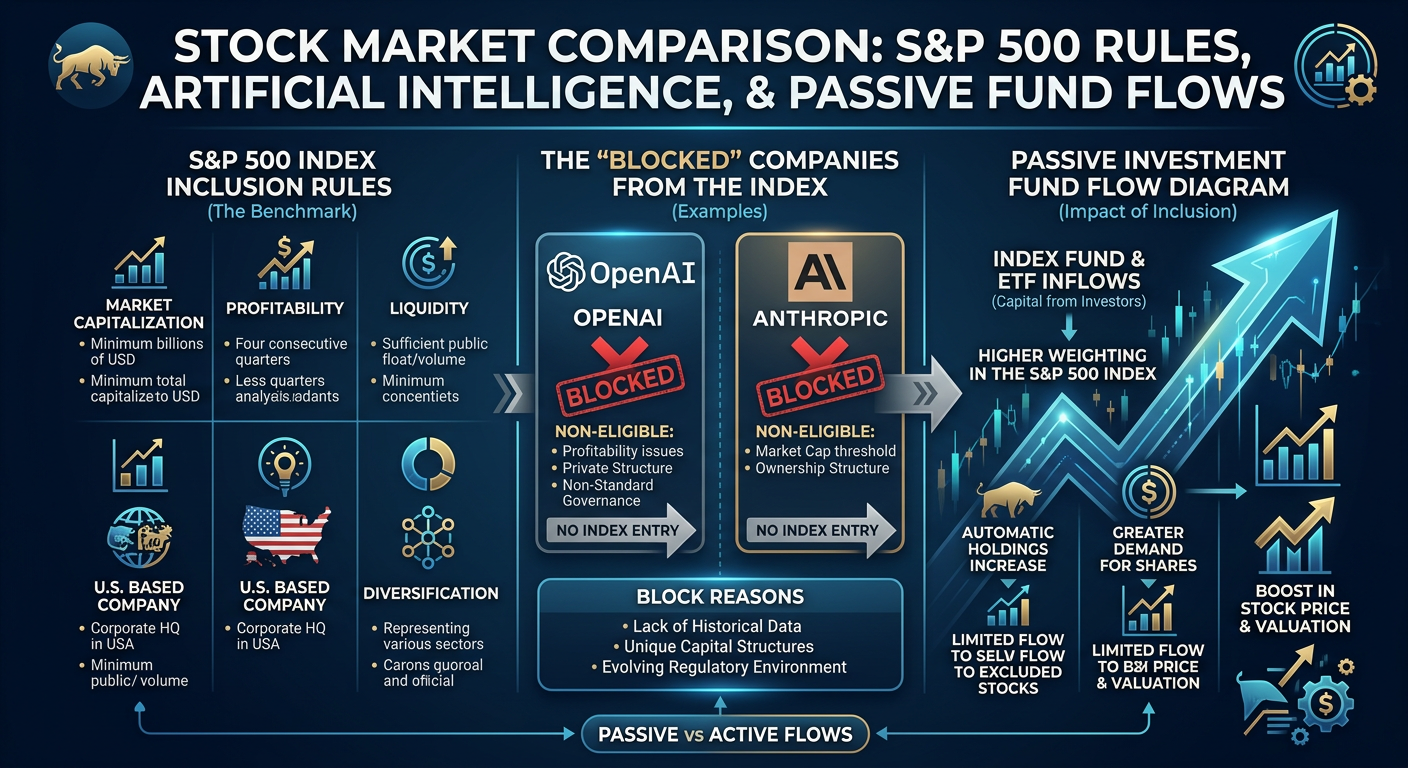
S&P Dow Jones Indices refuses to modify index rules for SpaceX, also blocking OpenAI and Anthropic from $7.5T passive fund pool. SpaceX loses $14B, OpenAI $8B, Anthropic $4.6B in potential passive buying. HN 427 points, 137 comments — community breathes relief.
Public-source compilation
Synthesized from public posts/docs. Prefer the original source for primary claims.
How we review content · Primary source · independent-research
Key Takeaways
On June 4, 2026, S&P Dow Jones Indices made a decision that sent shockwaves through Wall Street and the AI industry: it refused to modify index eligibility rules for SpaceX, effectively blocking SpaceX, OpenAI, and Anthropic from accessing billions of dollars in passive investment funds.
The critical numbers:
- SpaceX locked out: Up to $14 billion in passive fund buying expected by Bloomberg Intelligence evaporates — while SpaceX's debt has ballooned to $29 billion from AI infrastructure spending
- OpenAI and Anthropic affected too: Even after their IPOs, unprofitable AI companies may fail to meet S&P 500's profitability requirements
- OpenAI stood to gain $8 billion, Anthropic $4.6 billion in passive inflows — now off the table
- $7.5 trillion in passively managed funds (Vanguard, Fidelity, etc.) will operate under existing rules, no exceptions
Key Facts
- Date: June 4, 2026, S&P Dow Jones Indices official announcement
- Affected: SpaceX ($1.75T pre-IPO valuation), OpenAI, Anthropic, and all unprofitable AI unicorns
- Core change: S&P 500 refuses to create a fast track for "mega-cap" unprofitable companies
- Subtle exception: Nasdaq-100 and Russell already rolled out accelerated entry rules; S&P is the only major index holding the line
Background: A Month-Long Public Consultation
Before SpaceX's request, S&P Dow Jones Indices held a month-long public consultation to evaluate whether to modify eligibility rules for companies with "unprecedented market capitalizations."
This was no small matter. The S&P 500, as the world's most influential stock index, tracks approximately $7.5 trillion in passively managed funds. Investment strategies that automatically purchase S&P 500 constituents (like Vanguard Total Stock Market Index, Fidelity's passive funds) allocate capital proportionally. Admission to the S&P 500 means an automatic and continuous stream of passive buying.
SpaceX's request was "unprecedented" — it demanded:
| Requirement | Current Rule | SpaceX's Request |
|---|---|---|
| Post-IPO seasoning period | 12 months | Shorten to 6 months |
| Minimum public float (IWF) | At least 10% | Exempt (SpaceX plans only 3%) |
| Profitability | Current quarter + prior 4 quarters profitable | Full exemption (SpaceX is loss-making due to AI infra spending) |
| Market cap threshold | Mega-cap level | SpaceX at $1.75T far exceeds threshold |
Had these rules been bent for SpaceX, OpenAI (similarly loss-making at IPO) and Anthropic (sustained R&D losses) would naturally follow through the same fast track.
The S&P 500 Decision: No Exceptions, No Compromise
In its final decision on June 4, S&P Dow Jones Indices stated unequivocally:
"No changes will be made to the eligibility criteria including financial viability screens, seasoning period, or minimum IWF."
The terse declaration carried one signal: even a company approaching $2 trillion in valuation cannot force the index to break its own rules.
However, S&P Dow Jones Indices did make one concession — modifying investable weight factor rules for "lower-profile benchmarks" like the S&P Total Market Index and Dow Jones US Total Stock Market Index. This means SpaceX can enter these secondary indices faster, though the capital flow is a fraction of what S&P 500 would provide.
The decision sparked widespread discussion on Hacker News (427 points, 137 comments), with most users expressing relief.
HN user comment: "As a passive investor, I want the indices to follow the same passive strategy they always have, and specifically not make exceptions for specific companies like SpaceX wanted."
Another HN user: "Dodged a bullet... seems like they still have integrity."
Three Indexes, Three Attitudes
Comparing the entry rules for SpaceX/OpenAI/Anthropic across indexes reveals a stark divergence:
| Index | Entry Rule | Stance | Passive Fund Scale |
|---|---|---|---|
| S&P 500 | No rule changes; 12-month wait + profitability required | ❌ Strict | ~$7.5T |
| Nasdaq-100 | Already changed to 15 trading days accelerated entry | ✅ Friendly | ~$1T+ |
| Russell Top 500 | 5th trading day after IPO accelerated entry | ✅ Friendlier | ~$100B+ |
| FTSE Russell | Already revised rules for follow-on companies | ✅ Supportive | ~$100B+ |
Wall Street's interpretation: the S&P 500 represents "the eligibility standard for America's highest-quality companies" — by insisting on profitability and financial stability, it signals that traditional investment principles will not be swayed by the AI bubble.
What This Means for AI Companies
For OpenAI and Anthropic preparing for IPOs, this decision's impact goes beyond lost passive capital:
1. Narrower funding paths Both OpenAI and Anthropic burn cash intensely — training next-gen models, building data centers, expanding teams. Passive funds were a reliable capital source. S&P 500's closure means they must rely more on active investors and private markets.
2. IPO expectations reset Morningstar analysts had already called SpaceX "significantly overvalued" — valuing it at $780 billion, less than half of its $1.75T IPO target. OpenAI and Anthropic face even greater valuation controversy. S&P 500's rejection reinforces the narrative that "these companies aren't ready for mainstream investment."
3. Ecosystem chain reaction Current AI capital supply depends heavily on: strategic investments from tech giants (Microsoft → OpenAI, Google → Anthropic) + speculative private capital. The S&P 500's negative signal may make broader institutional investors more cautious about AI companies.
Practical Implications
This event sends three clear signals for AI tool users, practitioners, and investors:
1. AI company fundamentals are being market-tested S&P 500's rejection will force OpenAI and Anthropic to present clearer profitability paths at IPO. For AI tool users, expect API pricing to stabilize (demonstrating predictable revenue to investors), but large discount windows will narrow over the next 1-2 years.
2. Differentiation becomes the battleground again
When the "big pool" of free money closes, AI companies must compete on product differentiation and user stickiness. This is actually good news for tightly integrated workflow tools like Claude Code, Cursor, and n8n — users won't switch tools based on company funding news.
3. Watch Nasdaq-100 and FTSE Russell index premiums While S&P 500 said no, Nasdaq-100 and Russell are actively embracing AI companies. If OpenAI or Anthropic first access passive capital through Nasdaq-100, two different funding curves may emerge — worth monitoring.
Internal Links
- Want to evaluate AI tool ROI? See: AI Coding Agent Selection Guide
- Real case: Using Claude Code + n8n for automated workflows: Freelancer n8n Claude Real Estate Lead Scoring
Tool Mentions
This article naturally references OpenAI, Anthropic, Claude Code, n8n, and Cursor as AI tools and companies shaping the ecosystem.
Monetization angle
How can you make money from this trend?
WayToClawEarn focuses on verified earn playbooks—not just news. Start from these cases.
n8n + OpenAI affiliate site
Automate content and affiliate monetization
Claude + n8n automation agency
Charge monthly for agent workflow builds
Related tutorials
Related news
- OpenAI Models Land on Google Cloud: Three-Cloud Coverage Complete, Codex Agent Workflows How to Choose
- Anthropic Launches Claude Duet: Proactive AI Agent vs Meta Muse vs OpenAI Dots — How to Choose
- THUNLP Open-Sources PilotDeck 2.0: Workspace Isolation + Smart Routing, Agent Task Cost to 1/6?
- Zhipu Open-Sources GLM-Legal: Harvey LAB #1 Open-Weight, How to Choose Legal AI?