AI Academic Crisis Double Blow: Berkeley CS Failure Rate Hits 35%, 16 Mathematicians Issue Leiden Declaration
UC Berkeley CS sees historic failure rates in Spring 2026 with 35.3% F's in CS 10; the same week, 16 mathematicians publish the Leiden Declaration warning AI threatens the foundations of mathematics.
Public-source compilation
Synthesized from public posts/docs. Prefer the original source for primary claims.
How we review content · Primary source · Independent research / HN
Key Takeaway
Two independent events in the same week point to the same trend from different angles -- AI is systematically eroding foundational academic and mathematical skills.
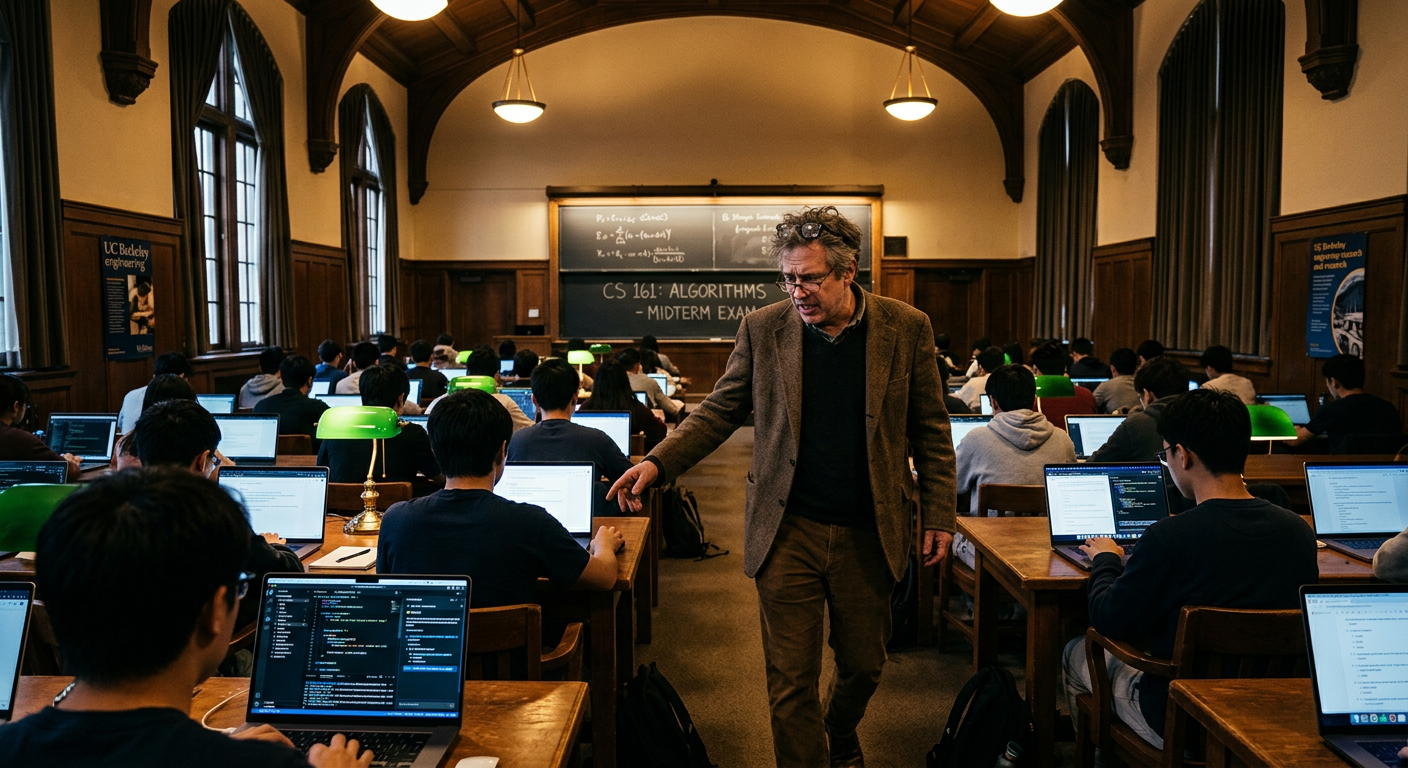
Event 1: UC Berkeley's Computer Science department posted historic failure rates in Spring 2026 -- CS 10 intro course saw 35.3% F rate, CS 61A saw 10.6%, and EECS 127 advanced optimization hit 16.8%. Professors cite AI cheating and declining math preparation as primary drivers.
Event 2: On June 2, 2026, 16 mathematicians from 15 universities published the Leiden Declaration on Artificial Intelligence and Mathematics, formally warning that AI threatens mathematical proof reliability, peer review systems, and research autonomy. The declaration is formally endorsed by the International Mathematical Union (IMU).
One story from the classroom floor, the other from the highest levels of mathematical research. Both converge on the same answer: AI is making "actually knowing" suspect.
Berkeley CS Failing Grades: Behind the Numbers
How Bad Is It?
According to Berkeleytime, the campus's internal grade data platform:
| Course | Spring 2026 F Rate | 2024-2025 Spring Avg | Dept Target |
|---|---|---|---|
| CS 10 (Intro) | 35.3% | <10% | ≤7% D/F |
| CS 61A (Fundamentals) | 10.6% | <10% | ≤7% D/F |
| EECS 127 (Optimization) | 16.8% | ~5% | ≤7% D/F |
CS 10's 35.3% failure rate means 1 in 3 students failed. Both courses averaged a 2.3 GPA (C+), well below the department's target of 2.8-3.3.
Professor's Eyewitness Account
Professor Dan Garcia, who taught both CS 10 and CS 61A in Spring 2026, reported that nearly 30 students in CS 10 alone were caught cheating on take-home exams. Garcia created the "Beauty and Joy of Computing" (BJC) curriculum that forms the backbone of CS 10 and Berkeley's pre-college summer CS academy.
He's not alone. Over 1,300 UC faculty members have signed a petition raising these issues about AI misuse and declining math skills.
Why AI Broke the Assessment System
A Berkeley study found roughly a 30% spike in A grades immediately after ChatGPT's release. Students used AI to complete assignments and got high marks -- but then failed exams that tested actual conceptual understanding.
The challenge is structural. Programmable calculators in the 1980s, internet search in the 1990s, smartphone apps in the 2000s -- each disrupted assessment before educators adapted. But AI is different: it's faster, more capable, and much harder to detect.
Professors can no longer distinguish between "using AI to study" and "letting AI do the work." Traditional take-home programming assignments became meaningless overnight -- just paste the prompt and ChatGPT writes the code.
The Leiden Declaration: 16 Mathematicians' Formal Warning
The Document
On June 2, 2026, a working group of 16 researchers from 15 universities published the 11-page Leiden Declaration on Artificial Intelligence and Mathematics. It's not anti-AI -- it systematically identifies five threats AI already poses to mathematical research.
Five Threats
| Threat | Core Issue |
|---|---|
| False proofs | AI can generate plausible-but-incorrect mathematical arguments that are hard to distinguish from correct proofs |
| Attribution ambiguity | AI-generated proofs have no clear author, making academic credit impossible to assign fairly |
| Loss of autonomy | Pressure to use AI tools erodes mathematicians' independent judgment |
| Non-participant penalty | Researchers who choose not to use AI are systematically disadvantaged in publication speed and output |
| Military/surveillance misuse | Mathematicians' work may be used to train AI for military and surveillance purposes |
Specific Recommendations
- Mandatory disclosure: All math papers must include a "Disclosure of Tools and Computational Resources" section
- Human-only authorship: Only humans can be responsible for paper content, even when AI is used
- Traditional publishing first: Research should continue through peer-reviewed journals and conference proceedings
- Support low-resource institutions: Ensure underfunded universities have access to AI tools
The declaration is formally endorsed by the International Mathematical Union (IMU). IMU Vice President Ulrike Tillmann stated: "While AI opens up exciting new opportunities, it also creates problems that cannot be ignored. The future of mathematical research should be guided by human judgment, fair and transparent practices, and the shared values of the international mathematical community."
Comparison: Two Levels of AI Academic Crisis
| Dimension | Berkeley CS Failing Grades | Leiden Declaration |
|---|---|---|
| Level | Undergraduate education | Frontier academic research |
| Core problem | AI cheating breaks exams, math foundations erode | AI generates false proofs, threatens peer review |
| Evidence | 35.3% F rate, 30 caught cheating, 1300+ faculty signatures | 16 mathematicians, 15 universities, IMU endorsement |
| Timeline | One semester (Spring 2026) | Long-term structural risk |
| Solutions | Proctored coding exams, AI-inclusive curriculum, separate assessments | Mandatory tool disclosure, human-only authorship, traditional publishing first |
| Common thread | AI is blurring the standard for what it means to "know" something |
HN Community Reaction
The Berkeley story reached 386 points with 51 comments on Hacker News, with polarized reactions:
Pro-"AI is the problem": Berkeley's data is a canary in the coal mine. If UC Berkeley's CS program can't handle it, other schools are worse off. CS 10's 35% failure rate isn't student failure -- it's assessment system collapse.
Skeptical of over-attribution: Berkeley's CS courses have always had high attrition rates. Grade fluctuations may be caused by multiple factors (curriculum changes, faculty turnover, admissions policy), not just AI. The Leiden Declaration was also criticized as "defensive traditionalism."
Practical Takeaways
-
Focus on conceptual understanding, not homework completion: AI can write code but can't understand why. Berkeley's data shows students who relied on AI for assignments failed when real understanding was tested.
-
Companies should prioritize hands-on interviews: If university transcripts are unreliable (AI cheating risk), employers need technical interviews and project portfolios to assess real ability.
-
Math and algorithmic foundations remain an unmovable moat: No matter how powerful AI gets, the ability to understand underlying logic separates great engineers from tool users.
References
- Daily Californian: "Failing grades soar as professors see greater AI usage, dwindling math skills in UC Berkeley CS classes" (June 3, 2026)
- Science / AAAS: "Mathematicians issue warning as AI rapidly gains ground" by Celina Zhao (June 2, 2026)
- Leiden Declaration on Artificial Intelligence and Mathematics (June 2, 2026)
- The Brief: "Why UC Berkeley CS Students Are Failing at Record Rates" (June 4, 2026)
- Hacker News discussion (item 48392004, 386 points)
Monetization angle
How can you make money from this trend?
WayToClawEarn focuses on verified earn playbooks—not just news. Start from these cases.
n8n + OpenAI affiliate site
Automate content and affiliate monetization
Claude + n8n automation agency
Charge monthly for agent workflow builds
Related tutorials
Related news
- OpenAI Models Land on Google Cloud: Three-Cloud Coverage Complete, Codex Agent Workflows How to Choose
- Anthropic Launches Claude Duet: Proactive AI Agent vs Meta Muse vs OpenAI Dots — How to Choose
- THUNLP Open-Sources PilotDeck 2.0: Workspace Isolation + Smart Routing, Agent Task Cost to 1/6?
- Zhipu Open-Sources GLM-Legal: Harvey LAB #1 Open-Weight, How to Choose Legal AI?