AI Cost Crisis from Both Sides: Uber Caps $1,500/Month AI Tool Spending, DDR5 RAM Surges 4x to $375
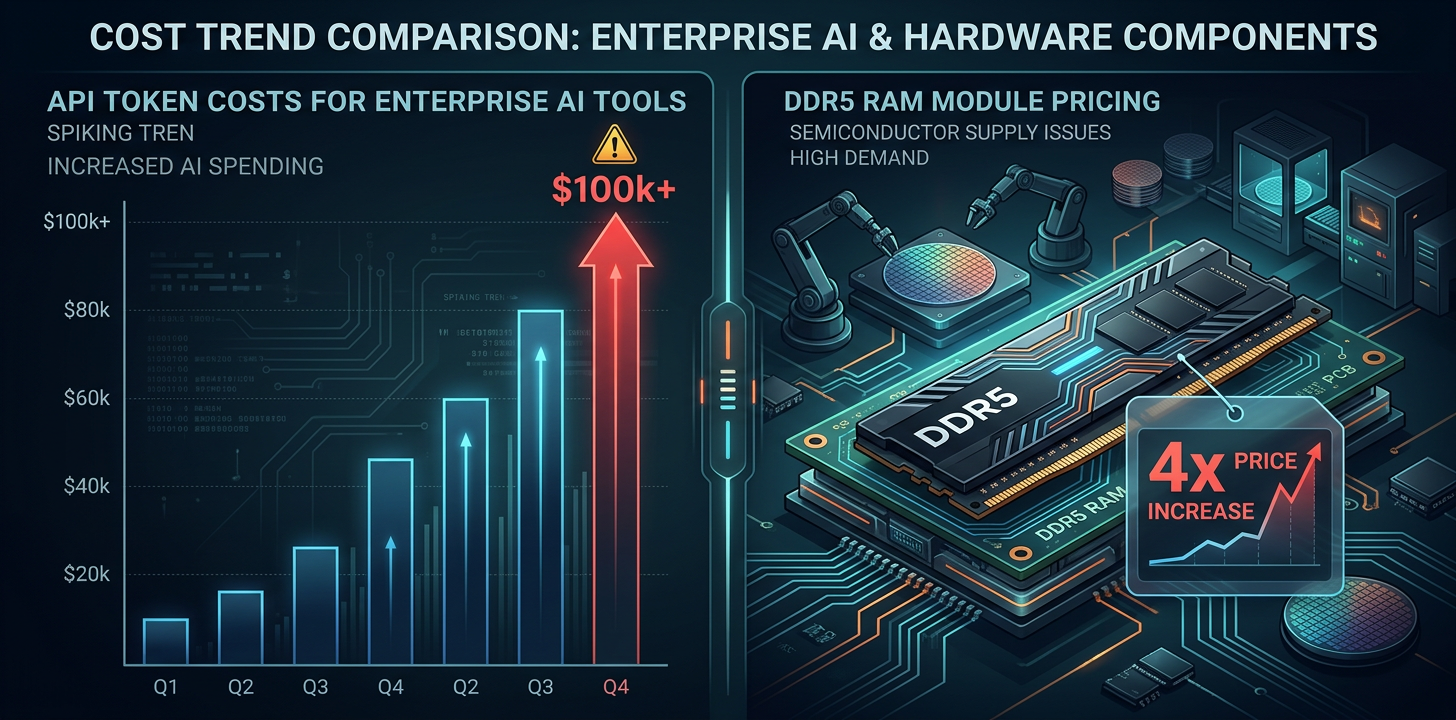
Uber burned through its 2026 AI budget in 4 months, capping employee AI tool spending at $1,500/month per person. DDR5 32GB RAM hit $375, up 4x from under $100 a year ago. The AI industry cost structure is breaking from both software and hardware ends, hitting indie devs and small teams hardest.
Public-source compilation
Synthesized from public posts/docs. Prefer the original source for primary claims.
How we review content · Primary source · Bloomberg / Tom's Hardware / HN
Key Takeaways
AI development and deployment costs are surging from both software and hardware fronts simultaneously. Uber burned through its entire 2026 AI budget in just four months, forcing a $1,500 per employee monthly token spending cap. Meanwhile, DDR5 RAM prices have skyrocketed 4x in one year, pushing a 32GB kit to $375. This isn't an isolated incident—it's a systemic cost structure imbalance across the AI industry.
Key Points
- Software cost: Uber employees now average over $1,500/month in AI coding tool tokens (Claude Code / Cursor), with annual budgets exhausted in 4 months
- Hardware cost: DDR5 32GB went from under $100 to $375 in one year, as AI data centers' scramble for HBM and GDDR memory squeezes consumer DRAM wafer capacity
- Impact: Independent developers and small teams are hit hardest by both cost surges simultaneously
- Signal: Both stories hit HN front page on the same day (combined 425 pts, 429 comments), showing the community's cost anxiety has reached a tipping point
Story 1: Uber's AI Bill Overshoot
On June 2, 2026, Bloomberg reported that Uber has implemented AI coding tool spending caps across all employees: $1,500 per person per month per tool. This means Claude Code spending doesn't eat into Cursor's allocation.
Uber burned through its entire 2026 AI budget in the first four months. Internally, this is called "AI Sticker Shock."
According to follow-up reporting from TechCrunch and The Information, Uber's AI budget problem surfaced as early as April, when internal discussions considered completely disabling some tools. Management ultimately chose "caps over bans."
Simon Willison noted on his blog that the $1,500/month figure itself is informative—it means Uber's actual cost for heavy AI users is much higher; the cap is just a "stop-bleeding" measure.
| Dimension | Value | Significance |
|---|---|---|
| Monthly cap | $1,500/person/tool | ~$50/day for heavy users |
| Budget burn | Full 2026 budget = 4 months | 3x overspeed |
| Tools covered | Claude Code, Cursor, etc. | Each tool has independent cap |
| Impact scope | All technical roles company-wide | Not just one department |
Story 2: DDR5 RAM Price Surge
Tom's Hardware reports that 32GB DDR5 RAM kits now cost $375 (minimum price) as of June 2026, up from under $100 a year ago. The root cause isn't DRAM manufacturer monopoly—it's AI's insatiable demand for HBM (High Bandwidth Memory) and GDDR VRAM squeezing consumer DRAM wafer capacity.
Intel publicly stated that "something has to give in the memory market." HBM3e costs 3-5x more per bit than DDR5, but AI data centers are willing to pay, which is distorting the entire DRAM pricing structure.
Specifically:
- Capacity squeeze: HBM3e production consumes DRAM wafer capacity; SK Hynix, Samsung, and Micron all prioritize their most advanced nodes for HBM
- Data center priority: AI servers use DDR5 for CPU main memory, with 2-3x the DDR5 allocation of traditional servers
- Consumer squeezed out: PC DIY builders, gamers, and independent developers are forced to pay premiums for limited DDR5 wafer capacity
Comparison: Two Cost Dimensions
| Dimension | Uber AI Cap (Software) | DDR5 Price Surge (Hardware) |
|---|---|---|
| Cost type | API token consumption (OpEx) | Hardware procurement (CapEx) |
| Increase | 3x budget overshoot | 4x price increase |
| Timeline | Jan-Apr 2026 | Q2 2025 → Q2 2026 |
| Direct impact | Large teams reduce AI coding dependency | Small teams can't afford dev machines |
| Indirect impact | Companies revoke AI tool privileges | Devs return to DDR4 or cloud-only |
| Beneficiaries | Claude Code/Cursor competitors (open source alternatives) | Used hardware market |
| Relief horizon | Short-term (adjustable caps) | Medium-term (12-18 months for capacity adjustment) |
Impact on Developers: The Double Squeeze
When both cost categories rise simultaneously, the middle layer—independent developers, small teams, and freelancers—gets hit hardest.
- Large companies: Can absorb costs through internal caps, enterprise discounts, and self-hosted inference infrastructure. Uber's case shows even they're feeling the pressure, but they at least have "caps" as a tool.
- Individual devs: Want an RTX 5090 for local models? DDR5 price surge means total build costs are through the roof. Using cloud APIs? GPT-4o and Claude Opus output token prices keep rising.
- Small teams: Most vulnerable. No enterprise bargaining power, no individual's flexibility.
Three Actionable Strategies
- Prioritize local inference: For daily coding assistance, deploy 8-12B parameter local models (like DeepSeek Coder V3 Local, Llama 4 Scout), reserving API calls for complex tasks. A 32GB Mac Mini is enough for quantized models.
- Hybrid token budget: Don't lock your entire AI budget into one tool. Claude Code is expensive for long-context analysis, Cursor for completion count. Switch tools by scenario—one $1,500 cap can stretch across multiple tools.
- Watch open source alternatives: DeepSeek V4 Pro's 90% price cut is a signal—price wars are happening. DDR5 wafer capacity is expected to gradually ease by H1 2027. For now, prioritize cloud VMs with quantized models over pure API or pure local approaches.
Community Reaction
Both stories dominated HN's front page simultaneously, with the community discussion showing palpable anxiety:
"$1,500/year × N engineers—even if half of Uber's 10,000+ employees use AI tools, that's $90M+. AI coding tools do improve productivity, but this cost structure is unsustainable."
"DDR5 at $375 means my next dev machine will cost $1,500+ just for RAM. Three years ago a complete PC cost that much."
The community consensus: both events point to the same conclusion—the AI industry is experiencing "growth-stage cost pains," but relief is 12-18 months away.
Internal Links
- Want to run local AI models to save costs? See: Local AI Model Deployment Guide
- Real case: Independent Developer Saves $1,200/month by Switching from Claude Code to DeepSeek V4
Next Steps
The AI cost crisis isn't a temporary fluctuation—it's an inevitable stage of industry restructuring. For developers, now is the optimal time to reassess your AI tool cost structure. Not to abandon AI coding, but to learn how to make every API dollar count.
Monetization angle
How can you make money from this trend?
WayToClawEarn focuses on verified earn playbooks—not just news. Start from these cases.
n8n + OpenAI affiliate site
Automate content and affiliate monetization
Claude + n8n automation agency
Charge monthly for agent workflow builds
Related tutorials
Related news
- OpenAI Models Land on Google Cloud: Three-Cloud Coverage Complete, Codex Agent Workflows How to Choose
- Anthropic Launches Claude Duet: Proactive AI Agent vs Meta Muse vs OpenAI Dots — How to Choose
- THUNLP Open-Sources PilotDeck 2.0: Workspace Isolation + Smart Routing, Agent Task Cost to 1/6?
- Zhipu Open-Sources GLM-Legal: Harvey LAB #1 Open-Weight, How to Choose Legal AI?