Claude Code After June 15: Complete Migration & Cost Optimization Guide (2026)
Everything Claude Code users need to know about the June 15, 2026 billing restructure — plan selection, cost projections, model tiering, and 6-step optimization strategy.
进阶 · 25 分钟 · 2026年6月9日
TL;DR: What Changes on June 15, 2026
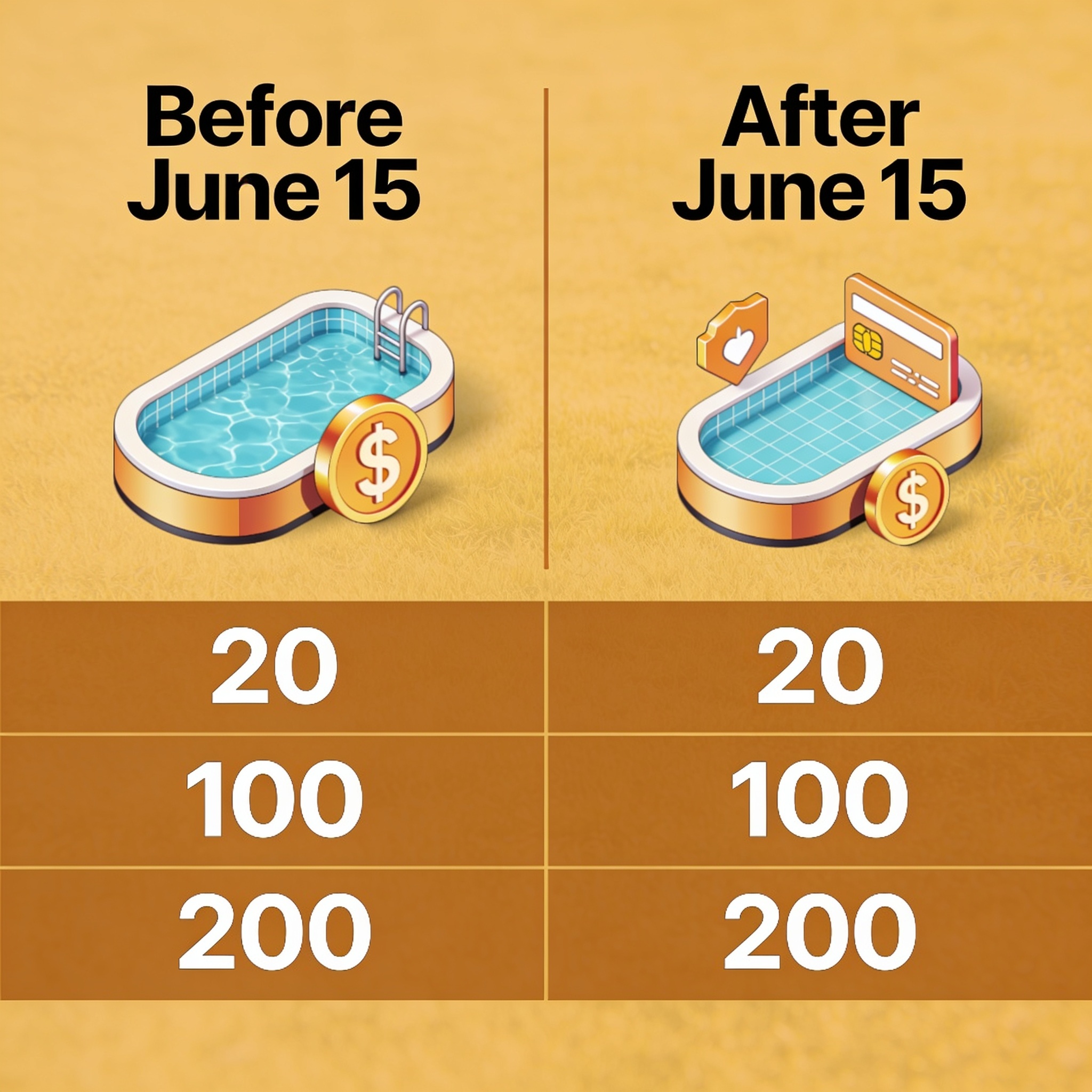
On June 15, 2026, Anthropic splits Claude Code's programmatic usage off your subscription pool into a separate, dollar-denominated monthly credit billed at full API rates. Your subscription price stays the same — but how far that money goes changes dramatically.
| Plan | Monthly Cost | New Credit Pool | Equivalent Opus 4.7 Tokens (est.) |
|---|---|---|---|
| Pro | $20/mo | $20 credit | ~200K input + ~40K output |
| Max 5x | $100/mo | $100 credit | ~1M input + ~200K output |
| Max 20x | $200/mo | $200 credit | ~2M input + ~400K output |
Source: Anthropic Help Center, Claude Pricing Page, CodersEra Analysis
If you're among the 18% of professional developers who use Claude Code daily (JetBrains 2026 Developer Ecosystem Survey), this guide provides the exact migration path, cost projection models, and optimization strategies you need before the deadline.
What's Actually Changing: The Two-Pool Split
Before June 15 (Current Model)
All Claude usage — interactive chat, terminal Claude Code, Agent SDK, claude -p — drew from a single, loosely metered subscription pool. The effective cost of programmatic usage was subsidized: a $20 Pro plan could theoretically drive agent workflows with API costs in the hundreds of dollars.
After June 15 (New Model)
Anthropic creates two independent pools:
| Pool | What It Covers | Metering |
|---|---|---|
| Interactive Pool | Claude.ai web/desktop/mobile chat, interactive Claude Code terminal sessions, Claude Cowork | Subscription rate limits (unchanged) |
| Programmatic Credit Pool | Agent SDK, claude -p non-interactive mode, Claude Code GitHub Actions, third-party agents via ACP | Full API rates, dollar-denominated |
Source: Anthropic Help Center announcement, Zed Blog analysis, The New Stack
The litmus test: If a Claude session runs without a human watching each turn — CI pipelines, cron jobs, autonomous agents — it moves to the new credit pool.
Step 1: Audit Your Current Programmatic Usage
Before you can optimize, you need to know your baseline. Here's how to audit your Claude Code usage across three dimensions:
1a. Identify All Programmatic Claude Workloads
Run this checklist against your infrastructure:
- Claude Code in CI/CD pipelines (GitHub Actions, GitLab CI, Jenkins)
- cron jobs calling
claude -p - Agent SDK-powered applications
- Third-party tools that authenticate via Claude subscription (Zed, Cursor with Claude, OpenClaw)
- Automated code review bots
- Batch processing scripts using Claude API
1b. Estimate Your Token Consumption
Use Anthropic's usage dashboard (available at console.anthropic.com) to check historical consumption. For programmatic workloads, a heavy Claude Code session debugging a non-trivial issue typically burns 500K-1M tokens.
Quick estimation formula:
# Estimate monthly programmatic token consumption
daily_sessions = 5  # Average agentic sessions per day
avg_tokens_per_session = 500_000  # 500K tokens per heavy session
work_days = 22

monthly_tokens = daily_sessions * avg_tokens_per_session * work_days

# = 55,000,000 tokens/month

# At Opus 4.7 API rates ($5/M input, $25/M output)

# Assuming 60% input / 40% output ratio:
input_cost = (monthly_tokens * 0.6 / 1_000_000) * 5    # $165
output_cost = (monthly_tokens * 0.4 / 1_000_000) * 25  # $550
total_cost = input_cost + output_cost                   # $715/month
Reality check: If your estimated cost exceeds your plan's credit, you need optimization (Steps 2-5). If it's well under, you can comfortably stay on your current tier.
1c. Factor in the Opus 4.7 Tokenizer Overhead
Critical detail most coverage misses: Anthropic's Opus 4.7 model uses a new tokenizer that encodes the same text into up to 35% more tokens than previous models. The listed API price hasn't changed — but you consume more tokens per prompt.
Source: Bind Blog analysis, Finout pricing guide
# Tokenizer overhead calculation
pre_june15_cost_per_prompt = 0.010  # $0.010 under old tokenizer
post_june15_cost_per_prompt = 0.010 * 1.35  # $0.0135 — same prompt, 35% more tokens

# For a typical developer day (20 agentic interactions):
daily_impact = 20 * (0.0135 - 0.010)  # $0.07 extra per day
monthly_impact = daily_impact * 22     # $1.54 extra per month
The tokenizer impact compounds on output-heavy tasks — generating entire files, test suites, or documentation.
Step 2: Choose the Right Plan Tier
Use this decision table based on actual usage patterns, not aspirational ones:
| Weekly Claude Code Hours | Usage Pattern | Recommended Plan | Est. Monthly API Cost |
|---|---|---|---|
| < 2 hours | Light code reviews, occasional refactors | Pro ($20) | $8-18 |
| 2-8 hours | Regular agentic coding, daily use | Max 5x ($100) | $40-90 |
| 8-20 hours | CI pipelines, multiple agents, heavy debugging | Max 20x ($200) | $120-190 |
| 20+ hours | Production agents, multi-repo CI, enterprise | API direct + Max 20x | $200+ |
Source: FindSkill.ai decision table, Verdent Guides
Practical tip: Anthropic's usage dashboard will show Claude Code credit consumption separately starting June 15. Monitor your burn rate in the first week and right-size your plan before your next renewal.
Step 3: Implement Model Tiering Strategy
The single highest-impact optimization: route tasks to the right model.
The Opus 4.8 Fast Mode Advantage
Claude Opus 4.8 in fast mode is approximately 3x cheaper than Opus 4.7 while being sufficient for most routine coding tasks. Opus 4.8 scores 58% on SWE-bench under the DeepSWE evaluation framework.
Source: Releasebot Claude Code Updates June 2026, Anthropic Official Blog
Model Selection Decision Tree
Task Complexity Assessment
    │
    ├── ROUTINE (linting, docs, boilerplate, simple refactors)
    │   └── Use: Opus 4.8 fast mode (~3x cheaper)
    │       Cost: ~$0.003-0.005 per interaction
    │
    ├── MODERATE (feature implementation, test writing, code review)
    │   └── Use: Opus 4.8 standard (~2x cheaper than Opus 4.7)
    │       Cost: ~$0.008-0.015 per interaction
    │
    └── COMPLEX (architecture decisions, novel codebases, debugging)
        └── Use: Opus 4.7 (full capability)
            Cost: ~$0.015-0.050 per interaction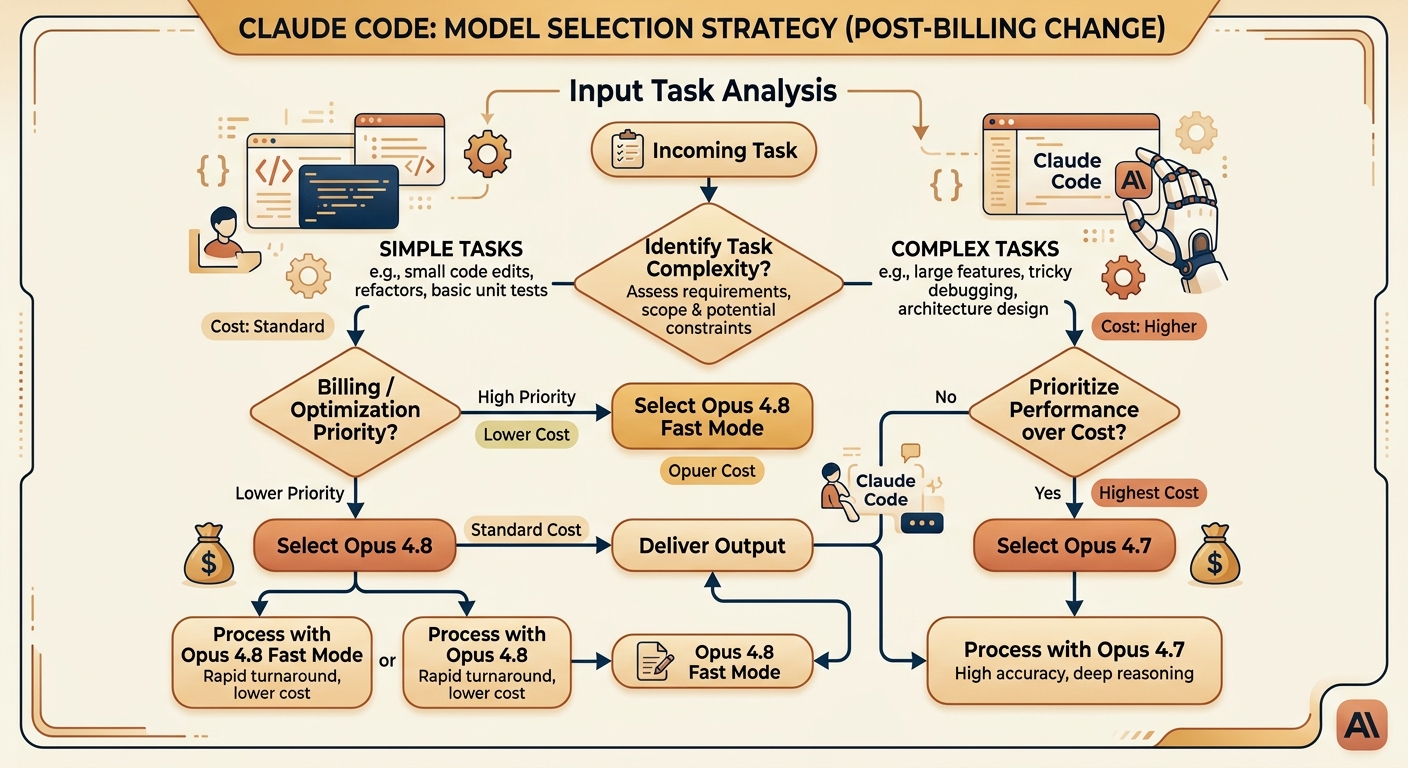
Implementation: Claude Code Model Selector
Create a .claude/settings.json in your project root to enforce model tiering:
{
  "model_tiering": {
    "default": "claude-opus-4-8-20250514",
    "fast_mode_enabled": true,
    "rules": [
      {
        "pattern": "*.test.*|*.spec.*|__tests__/*",
        "model": "claude-opus-4-8-20250514",
        "fast_mode": true
      },
      {
        "pattern": "docs/*.md|README.md|CHANGELOG.md",
        "model": "claude-opus-4-8-20250514",
        "fast_mode": true
      },
      {
        "pattern": "src/core/*|src/engine/*|infra/*",
        "model": "claude-opus-4-7-20250514",
        "fast_mode": false
      }
    ]
  }
}
Cost savings: Routing 70% of tasks to fast mode and 20% to standard Opus 4.8 can reduce your monthly Claude Code spend by 40-55% compared to using Opus 4.7 for everything.
Step 4: Implement Cost Optimization Toolkit
Once programmatic usage bills at API rates, the standard API cost-control toolkit applies:
4a. Prompt Caching
Claude supports prompt caching, which can reduce input token costs by 90% for repeated context:
# Enable prompt caching in Claude Code
export CLAUDE_CODE_CACHE_ENABLED=true
export CLAUDE_CODE_CACHE_TTL=3600  # 1 hour cache

# In CI pipelines, cache the system prompt
claude -p --cache-system-prompt "Review this PR for security issues: $(cat pr_diff.txt)"
Source: Anthropic Prompt Caching Docs
4b. Context Window Management
Smaller context windows = fewer tokens = lower cost:
# Set maximum context window based on task complexity

# Light tasks: 32K tokens (~$0.16 input at Opus 4.7 rates)
claude -p --max-context 32000 "Fix this linting error: $(cat error.txt)"

# Heavy tasks: 128K tokens (~$0.64 input)
claude -p --max-context 128000 "Architect the authentication system for this codebase"
4c. Token Budget Per Task
Implement per-task token budgets to prevent runaway agent loops:
# !/usr/bin/env python3
"""Claude Code cost-aware task runner with token budget enforcement."""
import subprocess, json, os, sys

TASK_TOKEN_BUDGET = {
    "lint": 50_000,
    "refactor": 200_000,
    "review": 300_000,
    "implement": 500_000,
    "architect": 1_000_000
}

def run_claude_task(task_type: str, prompt: str) -> dict:
    budget = TASK_TOKEN_BUDGET.get(task_type, 200_000)

    cmd = [
        "claude", "-p",
        "--max-tokens", str(budget),
        "--model", "claude-opus-4-8-20250514" if task_type != "architect" else "claude-opus-4-7-20250514",
        prompt
    ]

    result = subprocess.run(cmd, capture_output=True, text=True, timeout=300)

# Estimate cost
    est_output_tokens = len(result.stdout.split()) * 1.3
    est_cost = (est_output_tokens / 1_000_000) * 25  # Opus 4.7 output rate

    return {
        "task": task_type,
        "budget_tokens": budget,
        "est_cost": round(est_cost, 4),
        "output": result.stdout[:500]
    }

# Usage
result = run_claude_task("lint", "Check this file for PEP 8 violations and fix them")
print(f"Task: {result['task']}, Cost: ${result['est_cost']}")
4d. Pre-Claim Your Credit
Anthropic will send claim emails before June 15. You must claim your Agent SDK credit through your Claude account once — it then refreshes automatically each billing cycle. Check your email (including spam) around June 8-14.
Source: CodersEra checklist, Anthropic Help Center
Step 5: Build a Cost Monitoring Dashboard
Track your actual spend against budget in real-time:
# !/usr/bin/env python3
"""Claude Code monthly cost tracker with burn-rate alerts."""
import subprocess, json, time, os
from datetime import datetime, timedelta

# Configuration
MONTHLY_CREDIT = 100  # Max 5x = $100
ALERT_THRESHOLD = 0.75  # Alert at 75% consumed
LOG_FILE = os.path.expanduser("~/.claude/usage_log.jsonl")

def get_usage_data():
    """Fetch usage from Anthropic API."""
    api_key = os.environ.get("ANTHROPIC_API_KEY")
    cmd = [
        "curl", "-sS",
        "https://api.anthropic.com/v1/organizations/usage",
        "-H", f"x-api-key: {api_key}",
        "-H", "anthropic-version: 2023-06-01"
    ]
    result = subprocess.run(cmd, capture_output=True, text=True, timeout=10)
    return json.loads(result.stdout) if result.stdout else {}

def check_budget():
    today = datetime.now()
    days_in_month = 30
    days_elapsed = today.day

    usage = get_usage_data()
    programmatic_spend = usage.get("programmatic_credits_used", 0)
    burn_rate = programmatic_spend / max(days_elapsed, 1)
    projected = burn_rate * days_in_month

    status = "OK"
    if programmatic_spend > MONTHLY_CREDIT * ALERT_THRESHOLD:
        status = "WARNING"
    if programmatic_spend >= MONTHLY_CREDIT:
        status = "EXCEEDED"

    print(f"Day {days_elapsed}/30 | Spent: ${programmatic_spend:.2f} / ${MONTHLY_CREDIT}")
    print(f"Burn rate: ${burn_rate:.2f}/day | Projected: ${projected:.2f}")
    print(f"Remaining: ${MONTHLY_CREDIT - programmatic_spend:.2f} | Status: {status}")

    if status == "WARNING":
        print("\n⚠️ You've used 75% of your monthly credit.")
        print("Consider: switching to fast mode, reducing CI agent runs, upgrading plan.")

if __name__ == "__main__":
    check_budget()
Run this as a daily cron job or before starting your Claude Code session.
Step 6: Plan for the Worst Case — Migration Options
If your audited spend significantly exceeds your plan's credit, consider these alternatives:
| Alternative | Best For | Cost Profile | Claude Compatibility |
|---|---|---|---|
| DeepSeek V4 + Claude Code hybrid | 80% routine + 20% complex tasks | ~90% cheaper for routine | Uses Claude Code with custom API endpoint |
| Direct Anthropic API | High-volume programmatic with custom optimization | Pay-as-you-go, no subscription markup | Full control over model selection |
| OpenRouter | Multi-model access with unified billing | Varies by model, Claude via OpenRouter at API + margin | Works with Claude Code via custom base URL |
| GitHub Copilot | VS Code-native agentic coding | $10-39/mo flat rate | Different ecosystem, not Claude |
Source: See our DeepSeek V4 vs Claude Code guide for the hybrid setup tutorial.
Key Takeaways
- The subscription price doesn't change — but programmatic usage now has a hard dollar cap at full API rates.
- Interactive Claude Code terminal sessions are unaffected — only autonomous/scripted usage moves to the credit pool.
- The Opus 4.7 tokenizer adds ~35% overhead — factor this into all cost projections.
- Opus 4.8 fast mode is your primary cost lever — 3x cheaper for 70%+ of daily coding tasks.
- Credit does not roll over — unused credits reset each billing cycle. Use them or lose them.
- Audit before you optimize — you can't manage what you don't measure. Start with Step 1 today.
Pre-June 15 Action Checklist
- Audit all programmatic Claude workloads (CI, cron, SDK, third-party tools)
- Estimate monthly token consumption for each workload
- Apply the Opus 4.7 tokenizer overhead factor (×1.35) to projections
- Decide your plan tier using the decision table in Step 2
- Configure model tiering rules in
.claude/settings.json - Enable prompt caching for CI pipelines
- Set up the cost monitoring dashboard (Step 5)
- Claim your Agent SDK credit when the email arrives (~June 8-14)
- Monitor burn rate in Week 1 post-June 15, adjust tier before next renewal
💰 How Developers Earn Money With Claude Code
Claude Code isn't just a cost center — it's a revenue generator. Here are real developers who've built profitable businesses on Claude Code:
- Claude Code 48-Hour Startup: $9,000 MRR in 3 Months — One developer, $29/month Claude subscription, 48 hours to launch, now earning $9,000/month.
- DeepSeek V4 + Claude Code Micro-SaaS: $8,500/Month — How a solo developer built a micro-SaaS matrix combining DeepSeek's cost advantage with Claude Code's precision.
- Security Researcher: $10,000/Month Bug Bounty with Claude Code — Using Claude Code for automated vulnerability discovery and earning six figures in bug bounties.
- Claude Code + AWS SaaS: $12,000/Month in 3 Months — Full-stack AI SaaS built entirely with Claude Code, from infrastructure to frontend.
🔒 Pro Version: Advanced Cost Optimization
This is the Pro tier version of this guide. For the complete deep-dive including:
- Step 7: Multi-model routing architecture with fallback chains (DeepSeek → Opus 4.8 → Opus 4.7)
- Step 8: CI pipeline cost optimization with batched agent runs and smart caching
- Step 9: Enterprise team credit pooling strategies and cross-account optimization
- Step 10: Automated cost anomaly detection with Slack/email alerts
- Full cost projection spreadsheet for all 15 Claude Code usage patterns
Sources:
- Anthropic Help Center — Billing Changes
- Claude Platform Pricing
- Claude Plans & Pricing
- Bind Blog — Claude Code Pricing June 2026 Analysis
- CodersEra — June 15 Billing Change Guide
- FindSkill.ai — Decision Table
- Verdent Guides — Claude Code Pricing 2026
- Finout — Claude Code Pricing Guide
- Zed Blog — Subscription Changes Analysis
- Releasebot — Claude Code Updates June 2026
- JetBrains 2026 Developer Ecosystem Survey