OpenAI Files S-1 for $1T IPO as FrontierCode Reveals 50%+ of AI Code Is Unmergeable
OpenAI files confidential S-1 for September IPO at $1T+ valuation, while Cognition's FrontierCode benchmark reveals more than half of SWE-bench-passing code is unmergeable.
2026年6月9日 · 阅读约 5 分钟
Core Tension
Two stories hit Hacker News on June 8 that, taken together, tell an uncomfortable truth about AI coding in mid-2026.
Story A — OpenAI Files Confidential S-1 (327 points, HN) OpenAI confidentially submitted a draft S-1 registration statement to the SEC on May 22, formally beginning its path toward an IPO. The company is working with Goldman Sachs, Morgan Stanley, and JPMorgan, with CEO Sam Altman reportedly targeting a September 2026 listing. OpenAI's last private valuation stood at $852 billion (set during a $122 billion March 2026 funding round), with a $1 trillion IPO valuation target. The filing makes OpenAI the third major AI company heading to public markets in H2 2026, alongside Anthropic (confidential S-1, $965B valuation) and SpaceX (public S-1, SPCX ticker).
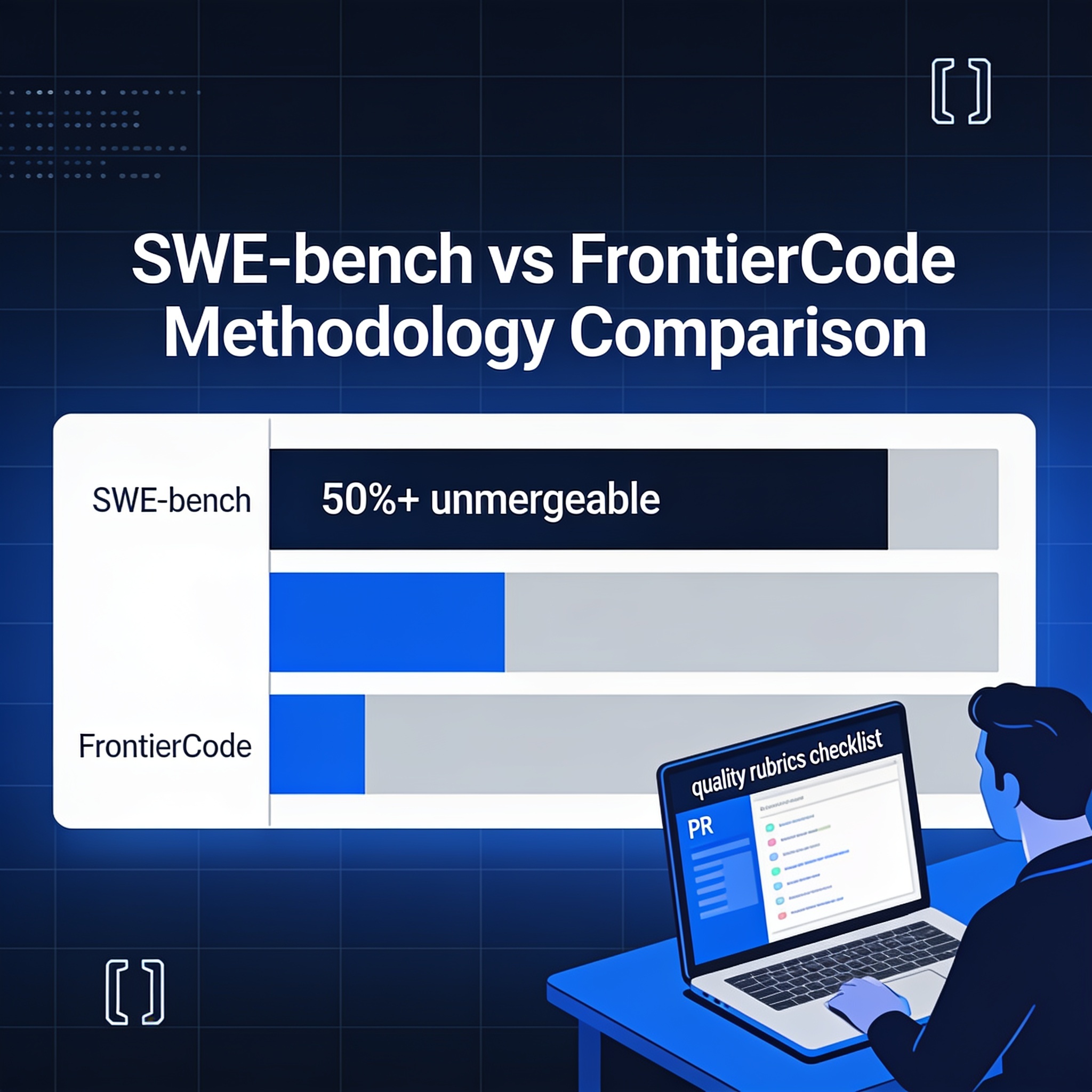
Story B — Cognition Launches FrontierCode (140 points, HN) Cognition (the company behind Devin) released FrontierCode, a new AI coding benchmark designed to test whether AI-generated code would actually be merged by human maintainers — not just whether it passes unit tests. The benchmark was built by IOI gold medalists and top open-source maintainers, and includes 3,000+ rubrics covering correctness, tests, scope, style, and maintainability. The headline finding, validated by METR: more than half of SWE-bench-passing PRs would not be merged into main. FrontierCode claims 81% fewer misclassification errors than SWE-Bench Pro.
The Two Stories, Side by Side
| Dimension | OpenAI S-1 Filing | FrontierCode Benchmark |
|---|---|---|
| What happened | Confidential IPO filing (May 22, announced June 8) | New coding benchmark released (June 8) |
| HN score | 327 points | 140 points |
| Core message | AI coding is a $1T market opportunity | Most AI coding outputs aren't production-ready |
| Evidence | $852B private valuation, Goldman/Morgan/JPM lineup | 3,000+ rubrics, METR validation, 50%+ SWE-bench outputs unmergeable |
| Who benefits | Investors, OpenAI employees, AI bulls | Engineering teams, maintainers, quality tool vendors |
| Emotional signal | Optimism, FOMO, market validation | Skepticism, caution, reality check |
Story A: OpenAI's $1T IPO Gambit
OpenAI's confidential S-1 filing on May 22 was expected — the company had been preparing for public markets since early 2026 — but the timing is notable. The filing comes just weeks after Anthropic submitted its own confidential S-1, and alongside SpaceX's public S-1 filing. Together, the three companies represent over $135 billion in AI capital shifting from private rounds to public markets in H2 2026.
Key numbers from the filing:
- Last private valuation: $852 billion (March 2026, $122B round)
- IPO target valuation: $1 trillion+
- Underwriters: Goldman Sachs, Morgan Stanley, JPMorgan
- Target listing: September 2026
- Structure: OpenAI Group PBC (public benefit corporation)
The filing hasn't revealed financials yet — confidential S-1s stay private until roughly 15 days before the public roadshow — but it's already forcing four key questions into the open: revenue trajectory, path to profitability, compute capex commitments, and the sustainability of the API business against cheaper competitors.
Story B: FrontierCode — Why SWE-bench Is Overrated
Cognition's FrontierCode benchmark addresses a problem many engineering teams have felt but couldn't quantify: test-passing does not equal mergeable.
The benchmark uses a fundamentally different methodology:
- Hand-selected by maintainers — Unlike SWE-bench (programmatic scraping from single PRs), FrontierCode uses multi-PR chains and freeform requests curated by project maintainers
- Multi-language — 3x the languages of SWE-Bench Pro
- 3000+ rubrics — Each PR is scored on correctness, test coverage, scope alignment, code style, and long-term maintainability
- METR-validated — The finding that "more than half of SWE-bench-passing outputs are unmergeable" was independently confirmed by METR
The practical implication: if your team is using SWE-bench scores to evaluate AI coding agents, you may be overestimating production readiness by 2x or more.
HN Community Reaction
The HN discussion on both stories reveals a community divided:
On the OpenAI IPO:
"A $1T valuation before we've seen the financials is pure narrative pricing. The question isn't whether AI is transformative — it's whether OpenAI captures enough of that value to justify this."
On FrontierCode:
"Finally a benchmark that tests what actually matters. I've been saying for months that SWE-bench scores are meaningless for production code. The maintainer knows best."
The most insightful comments connect the two stories:
"OpenAI is going public at $1T+ on the promise that AI coding agents will reshape software development. Cognition just proved that the current best agents can't write mergeable code half the time. Both things are true — but one is a bet on the future, the other is a report card on the present."
What This Means for Developers
- Don't read too much into SWE-bench alone — FrontierCode's methodology is more realistic. When evaluating coding agents, prioritize mergeability metrics over pass rates
- The IPO pipeline validates the thesis — $135B in AI public offerings means institutional investors believe in AI coding's long-term value, even if current quality has room to improve
- This tension is healthy — Market optimism funds the R&D that closes the quality gap. The $1T bet and the "50% unmergeable" finding exist in the same reality
Related Reads
- 📚 AI Coding Agent Tech Stack Selection Guide — How to evaluate coding agents beyond benchmark scores
- 📚 GitHub Copilot Pricing 2026: Every Plan Tested & Compared — Navigate usage-based billing
- 💰 Claude Code 48-Hour Startup: $9K/Month in 3 Months — Real money with AI coding
- 💰 Security Researcher Uses Claude Code for Bug Bounties: $10K/Month — When AI coding quality actually matters