Anthropic Reveals 80% of Internal Code Is Now AI-Written, Calls for Global Pause on Frontier AI
Anthropic's Institute published internal data showing Claude now authors over 80% of the company's merged production code, engineers ship 8x more code per quarter, and autonomous AI tasks have grown from 4 minutes to 12 hours in under two years. The report warns of accelerating progress toward recursive self-improvement and proposes a global coordination mechanism to pause AI development if risks escalate.
2026年6月9日 · 阅读约 4 分钟
Key Findings: The Acceleration Is Real
On June 4, 2026, Anthropic's newly established Anthropic Institute published a landmark report titled "When AI Builds Itself" — the first time any major AI lab has publicly shared its internal operational data on how AI systems are accelerating the development of AI systems.
The report landed on Hacker News with 527 points and 694 comments, and was covered by the WSJ, Reuters, Scientific American, and CNN. Its central claim: AI is approaching the threshold of recursive self-improvement — where systems can autonomously improve themselves without direct human intervention.
1. Claude Writes 80%+ of Anthropic's Production Code
The most striking data point: Claude now authors more than 80% of merged production code across Anthropic's entire codebase. Before the company shipped its in-house coding agent in February 2025, Claude wrote only low single-digit percentages of merged code.
This isn't a benchmark or a lab experiment — it's real production data from a company building frontier AI systems.
2. Engineering Output Up 8x Per Quarter
Anthropic's engineers now ship approximately 8x more code per quarter than they did a few years ago. Each engineer's merged output has increased dramatically, with the human role shifting from writing code to reviewing, steering, and orchestrating Claude's output.
The transition is visible across the entire development lifecycle: requirements, coding, testing, code review, and deployment. At every step, the human role is shrinking.
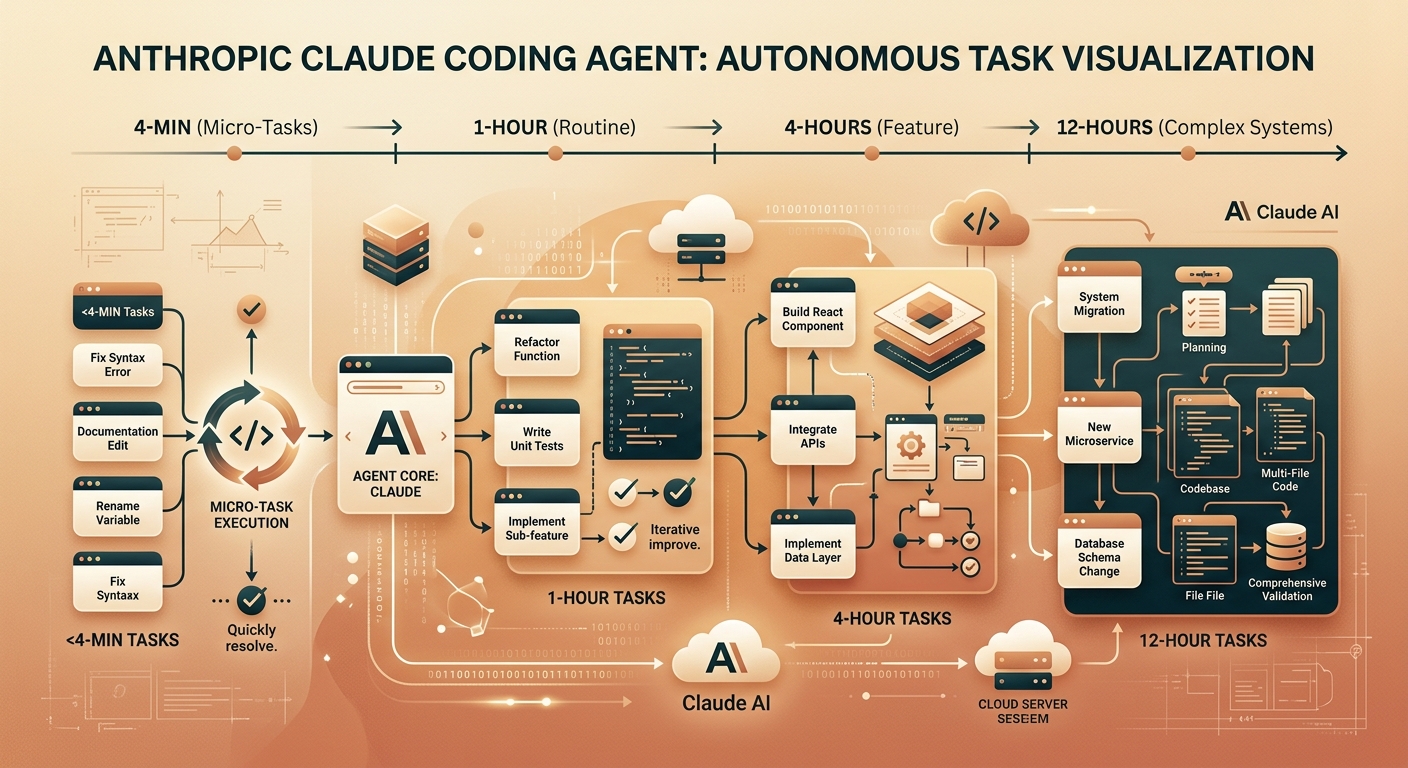
3. Autonomous Task Duration: From 4 Minutes to 12 Hours
Perhaps the most revealing metric in the report: the maximum duration of tasks that Claude can complete autonomously has grown exponentially.
| Period | Model | Max Autonomous Task Duration |
|---|---|---|
| Early 2024 | Claude 3 | ~4 minutes |
| Early 2025 | Claude Sonnet 3.7 | ~90 minutes |
| Early 2026 | Claude Opus 4.6 | 12 hours |
This represents a 180x increase in autonomous capability in just over two years — far outpacing Moore's Law-like expectations. Each generation of Claude can tackle longer, more complex tasks without human intervention.
4. The Recursive Self-Improvement Threshold
Anthropic defines recursive self-improvement (RSI) as the point where AI systems can autonomously improve their own capabilities — building better AI without human-driven research.
The report identifies three conditions for RSI:
- AI systems can generate high-quality training data — largely achieved
- AI can design and execute experiments — partially achieved
- AI can architect and implement novel model improvements — approaching
"If AI were able to improve itself without human involvement — recursively — then the pace of improvement could suddenly increase dramatically," the report warns.
5. The Global "Brake Pedal" Proposal
The Anthropic Institute didn't just document acceleration — it made a concrete policy proposal: a coordinated, verifiable global mechanism that would allow the world's leading AI labs to slow or temporarily pause frontier AI development.
Anthropic co-founder Jack Clark elaborated in multiple interviews:
"The AI industry right now has a gas pedal, but it doesn't have a brake pedal in the car, and we want to do some of the work to build that pedal."
The proposal includes:
- Verifiable compliance: Not just voluntary promises but trackable, auditable commitments
- Trigger conditions: Specific risk indicators that would activate a pause
- Collective action: All major labs must participate for the mechanism to work
HN Community Reactions
The HN discussion (681+ comments) was deeply divided:
Skeptics questioned whether Anthropic's internal data generalizes: "Claude writes 80% of their code because they're building AI products — not everyone builds AI."
Supporters pointed to the transparency: "This is the first time a major lab has released this kind of operational data. Even if you disagree with the conclusions, the data itself is valuable."
Critics saw a strategic motive: "Anthropic is arguing for regulation because they're ahead in safety but behind in scale. This isn't altruism — it's competitive positioning."
What This Means for Developers
- The coding role is shifting: Engineers who embrace AI as a partner rather than a tool will ship dramatically more. The bottleneck is no longer writing code — it's knowing what to build and how to validate it.
- Autonomous AI agents are real: The progression from 4-minute to 12-hour autonomous tasks means AI agents can now handle substantial portions of full-stack development. This isn't coming — it's here.
- Affiliate opportunity: Tools like Claude Code, GitHub Copilot, and Cursor are becoming essential infrastructure. Developers building workflows around these tools will be in high demand.
Next Steps
Anthropic's report may be self-serving — but the data is hard to dismiss. The 80% code authorship figure, 8x productivity gain, and 12-hour autonomous task ceiling are internally consistent and point in one direction: AI's role in building AI is accelerating faster than public benchmarks capture.
Whether you agree with the call for a global pause or not, one thing is clear: the developers who learn to work effectively with AI agents today will have a significant competitive advantage.
💰 How developers earn with AI tools: Check out our Claude Code Tutorials and real-world AI automation case studies for practical workflows that generate income.
📚 Learn Claude Code: Complete Guide to Claude Code in 2026